9 Best Cane Tips for Ice and Snow (November 2026)
The best cane tips for ice and snow include the Vive Cane Tips for Ice for most icy walks, the IMFENY Cane Tips Heavy Duty (best heavy duty rubber grip), and the BRMDT Cane Ice Tip Attachment (best simple 5 prong attachment).
On this page (8 sections)
- Best cane tips for ice and snow: our top picks
- How to compare cane ice tips for snow and ice
- How do cane ice tips work on ice?
- Which cane tip is best for ice: prongs or rubber?
- How do I measure my cane for a new tip?
- Can I flip up an ice tip for indoor use?
- How do I install and care for cane tips?
- Verdict: best cane tips for ice
The best cane tips for ice are 5 prong retractable attachments for icy sidewalks, because metal teeth bite where rubber slides. If you are still choosing a walking aid, compare a quad cane with a walker first.
For wet but not solid ice, a heavy duty rubber tip with a deep tread is quieter and safer indoors.
Our score weighs specs, features and buyer feedback against what you're shopping for. We compared prong design, fit, flip up use, tread and pack size for winter walking.
Our picks at a glance
-
1

-
2
-
3

Best cane tips for ice and snow: our top picks
The Vive leads for most icy walks, while rubber picks suit wet pavement and all season use. Active 5 prong models dominate the top of this list because ice is the main risk in the search.
Vive Cane Tips for Ice: Best for most icy walks
- 5 carbon steel prongs
- Flip up for indoor use
- Fits cane diameters 2 to 3.75 in
- 2 pack
Five prongs and a flip up design make this a strong all winter pick for canes, crutches and walkers.
Pros
- Bites into ice and snow
- Flips up for indoor use
- Works with canes, crutches and walkers
Cons
- Screw on fit takes more time than push on rubber
- Prongs need care on hard floors
Vive suits walkers who need one setup for snowy driveways, icy paths and indoor floors. Its 5 carbon steel prongs bite into snow and ice, and Vive says they also add stability on sand, loose gravel and soft grass.
That mix matters in winter, when one short walk can cross packed snow, then wet pavement, then a smooth indoor floor.
The flip up push mechanism lets you fold the ice section along the cane for indoor use. A slip resistant pad helps stop the attachment from sliding or scratching the cane shaft, which protects the finish on a standard cane or a folding cane.
That detail is easy to miss, but it decides whether the tip stays put after repeated flips.
It attaches with included hardware to cane diameters from 2 in to 3.75 in. Vive says it works on standard and folding canes, forearm crutches, axillary crutches and walkers, so the same idea can cover more than one aid.
The 2 pack means you can equip a cane and a spare, or replace a worn pair without a second order.
That wide fit range is a real trade off against push on rubber tips. You gain ice bite, but you trade a tool free swap for a screw on install that needs a tightness check.
For pure ice use, this is the most complete package here, and the trade is worth it on frozen ground.
IMFENY Cane Tips Heavy Duty: Best heavy duty rubber grip
- Deep groove tread
- High polymer rubber
- Fits 1 in shafts
- 1 pack
Thick rubber with a deep groove tread gives steady grip on wet surfaces and a quiet step indoors.
Pros
- Deep groove tread for wet floors
- Steel insert resists wear through
- Push on install with no tools
Cons
- Rubber will not bite into solid ice like prongs
- Single tip per pack
IMFENY suits daily cane users who walk on wet tile, hardwood, grass and pavement more than solid ice. Its deep groove tread bites into wet surfaces and helps the cane hold its place instead of sliding out.
The rubber base also softens each step and stays quiet, with no clicking and no marks on floors, which is a clear plus for indoor routes.
The tip uses heavy duty high polymer rubber, molded thick where cheap tips wear first. A stainless steel insert helps stop the metal pole from pushing through the rubber, and the shaft material is listed as stainless steel.
That construction is aimed at daily use, not at light or occasional use, so it should hold up better than a thin tip that splits early.
IMFENY says if the tip wears through within one year, it will send a new one at no cost. That wear through promise is rare in this group and matters for daily use, because it covers the exact failure most walkers fear.
You message with an order number and a photo, and no return is needed.
Fit is 1 in / 25 mm, and you get 1 tip per order. Measure the tube, not the old rubber tip, and order 2 if you want to replace a pair, since pairs wear unevenly.
Trade off: rubber is quiet and floor safe, but it will not bite into hard ice like 5 prongs.
BRMDT Cane Ice Tip Attachment: Best simple 5 prong attachment
- 5 steel teeth
- Flip up indoor mode
- 2 screws install
- 2 count
A straightforward flip up ice tip with 5 steel teeth for snow, sand, gravel and soft grass.
Pros
- 5 teeth bite into loose surfaces
- Flips up for indoor use
- Rubber gasket guards the cane
Cons
- Screw install needs a check for tightness
- Metal on hard floors needs flip up use
BRMDT suits walkers who want a simple flip up ice tip with a proven 5 tooth layout. Its 5 durable steel teeth bite into ice, snow, loose gravel and soft grass to reduce slips.
The coverage is listed as all terrain ice, snow, sand, gravel and grass, so the design is meant for mixed winter ground rather than for ice alone.
The reverse mechanism flips the tip up along the cane for indoor use. That keeps the teeth off cement and pavement, where they would wear fast and where metal can mark hard floors.
A rubber gasket helps prevent the attachment from sliding and scratching the cane, which is a small part that helps the mount stay stable.
Install uses 2 simple screws on most canes or crutches. The pack is a 2 count set with 2 packs and 2 pieces, so it can cover a pair of crutches or leave a spare for a cane.
That pack size suits walkers who use two aids, or who want a backup after the first tip loosens in cold weather.
Trade off against Vive: both use 5 prongs and flip up, but BRMDT gives less detail on fit range. Measure your cane diameter and confirm screw fit before you order, and recheck tightness after the first icy walk.
For a simple ice tip at a lower profile, this is a clean choice.
MFE Cane Tips 3/4 Inch: Best for 3/4 inch shafts

- 3/4 in fit
- 1.77 in wide base
- Steel washer support
- 2 pack
A wide 1.77 in base and textured tread add stability for standard 3/4 in canes and crutches.
Pros
- Wide base for balance
- Textured tread for traction
- Tool free push on fit
Cons
- Rubber alone may slide on hard ice
- Must measure shaft before ordering
MFE suits standard canes and crutches with a 3/4 in shaft who want a wide, stable rubber foot. Its 1.77 in wide base with textured tread adds traction on tile, pavement, gravel and grass.
A wider base spreads load across more rubber, so the cane feels less tippy when you shift weight during a step.
Thick rubber with an internal steel washer resists wear and deformation. MFE says the cushioning helps reduce vibration and improve balance for seniors and rehab users, and the shock absorption softens contact on hard ground.
That comfort matters on long indoor walks, where a hard tip can send a jolt up the shaft.
Install is tool free. Pull the old tip off and push the new one on for a snug, wobble free fit, with no tools needed.
The product size is listed at 2.4 by 1.8 by 1.8 inches, so the base is easy to picture against a standard cane foot.
The 2 pack is handy for a pair or for a spare. MFE notes the tip also fits 7/8 in shafts in some guidance, so measure the outside diameter at the bottom before you buy.
Trade off: this rubber grip is strong on wet pavement, but it cannot dig into solid ice.
MDUB Medical All Terrain Tip: Best for all terrain rubber use
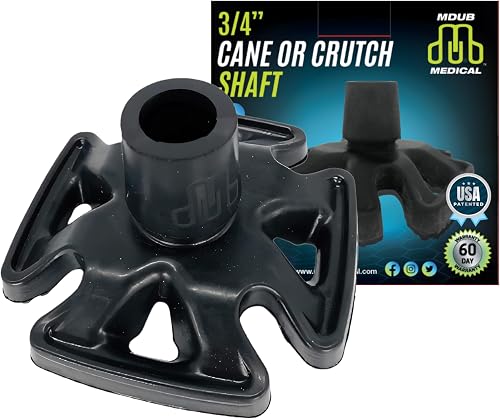
- 4x4 self standing design
- Shock absorbing rubber
- Fits 1 in cane tube
- 1 pack
A 4x4 self standing rubber tip that flexes with each step and works on sand, snow and smooth floors.
Pros
- Self standing for easy pickup
- Flexes to reduce hand fatigue
- Works on smooth and rough ground
Cons
- No metal prongs for solid ice
- Single tip per pack
MDUB suits walkers who want a self standing tip for smooth floors and light outdoor terrain. Its 4x4 self standing design lets the cane stand on its own for easy pickup when you are seated.
That feature helps in a diner, at a desk, or beside a chair, where a cane that falls is a cane you must bend to reach.
High wear pure rubber stays flexible in all weather. MDUB says the tip absorbs shock to reduce hand and wrist fatigue, and flexes with each step, so the foot works with your stride instead of against it.
The rubber is described as filler free and built for lasting durability through sand, snow, dirt and rain.
It fits most standard and folding canes with a 1 in cane tube. Install is a simple push and twist with no tools, and the package size is listed at 4.84 by 4.8 by 2.52 inches.
Fitting a 1 in tube is the key check, since a loose tip will wobble and a tight tip will not seat cleanly.
The non slip traction works on smooth floors, sand, snow, dirt and rain. That mix makes it a good year round rubber option.
Trade off: there are no metal prongs, so hard ice will still be slick.
BOXOB 2pcs Ice Cane Tip Attachment: Best for varied cane diameters

- 5 carbon steel prongs
- Fits 2 to 3.75 in diameters
- Long and short screws
- 2 pack
Two flip up ice tips with long and short screws for canes, forearm crutches and walkers.
Pros
- Two screw lengths for fit
- Flip up for indoor use
- 5 prongs for ice and snow
Cons
- Screw fit needs careful measuring
- Stainless steel prongs need indoor flip up
BOXOB suits walkers with canes or crutches in the 2 in to 3.75 in diameter range. Its 5 carbon steel prongs grip ice and snow and add balance on wet surfaces, sand, loose gravel and soft grass.
Coverage is listed as ice, snow, sand, loose gravel and soft grass, so the tips are built for the mixed ground that winter creates outside a front door.
The push mechanism flips the tip along the outside of the cane for indoor use. Anti slip pads help prevent slipping or scratching the cane, and that flip up step keeps the prongs off sidewalks and indoor floors.
Without that step, steel teeth would wear fast on cement and could mark tile.
You get 1 pair of long screws and 1 pair of short screws. That helps fit standard and folding canes, forearm crutches, armpit crutches and walkers, because different shafts need different screw lengths.
The product size is listed at 11 by 6.5 cm, and the pack holds 2 sets for a pair.
Trade off: screw fit by diameter needs care. Measure first, test tightness after install, and flip the tips up before you use hard indoor floors.
Stainless steel is named in the specs, so the prongs are aimed at hard winter use.
Dunzy 4 Pcs Cane Tips for Ice: Best value multi pack

- 5 prong retractable design
- Stainless steel
- Fits 2 to 3.75 in diameters
- 4 pack
Four retractable ice tips give you spares for canes, crutches and trekking poles in winter.
Pros
- 4 pieces for spares or sharing
- Retractable flip up design
- Stainless steel build
Cons
- More pieces than most walkers need
- Hardware install takes added time
Dunzy suits walkers who want spares, or who share winter gear with a friend. Its 4 pieces include 5 prong retractable tips, 8 screws and 8 black gaskets.
That hardware count is a real clue, because it means the pack is built for more than one cane and for repeat installs over a season.
The 5 prongs add balance and safety on ice and snow. The retractable flip up design lets you flip the tips along the cane with your fingers for indoor use, so the prongs stay off hard floors.
Coverage is listed as ice, snow and loose surfaces, which fits winter sidewalks and gravel paths.
Stainless steel build is described as strong, rust proof and long lasting. Fit range is about 2 in to 3.75 in for standard folding canes, forearm crutches, underarm crutches and walkers.
The listed weight is 349 g, and the size range matches other screw on ice tips in this group.
That extra quantity is the main trade off. You get more than you need for one cane, but spares help when a tip loosens or wears mid season.
Choose Dunzy for value in multiples, and choose a 2 pack if you only need one pair.
flexSTICK FlexTIP: Best for shock and uneven ground

- Bending flexible tip
- Shock absorbing
- Fits 3/4 in shafts
- Adds 1.25 in height
A bending rubber tip that keeps contact on uneven ground and helps absorb shock in your hand.
Pros
- Bends to stay on sloped ground
- Absorbs shock for hand comfort
- No tools to install
Cons
- Adds height to the cane
- Rubber will not dig into solid ice
flexSTICK suits walkers who lose contact on sloped or uneven ground. Its bending flexible tip adjusts to the surface, so more of the tip stays on the ground as the cane tilts.
Traditional cane tips lose contact as the cane tilts, and that loss of contact is what makes a slip more likely on a slope.
The tip absorbs shock to help ease pain in the hand, wrist and arm. A Lazy Susan style turn lets the handle rotate while the tip stays fixed, so the foot does not twist and slide when you turn your hand.
That turn is a small motion, but it changes how the tip grips on uneven paths.
It fits any standard 3/4 in diameter cane shaft, solid or aluminum. No tools are required for install, and the FlexTIP is sold as a replacement tip or as a complete unit with a cane.
Package size is listed at 3.94 by 2.09 by 2.05 inches.
FlexTIP adds 1.25 in to cane height. That is not a problem for adjustable canes, but fixed height canes may need a height adjustment after install.
Trade off: rubber flexibility helps on uneven paths, but it will not bite into solid ice.
supregear Cane Tips 3/4 Inch: Best budget 2 pack rubber tips

- 3/4 in fit
- Metal inserts
- Wide non slip base
- 2 pack
A 2 pack of thicker rubber tips with metal inserts for steady grip on grass, sand and paths.
Pros
- 2 pack covers a pair
- Metal inserts resist wear
- Tool free install
Cons
- No prongs for hard ice
- Must confirm 3/4 in shaft size
supregear suits budget buyers who want a 2 pack for a 3/4 in cane. Its thicker high grade rubber with metal inserts is built for longer wear than thin tips.
The metal inserts help the tip keep its shape under load, and the thicker rubber is meant to resist the wear that makes a tip smooth and slick.
The wide non slip base gives grip on uneven paths, boardwalks, grass and sand. Shock absorbing design helps reduce impact on hands and wrists, so the tip softens each step on hard ground.
Product size is listed at 2.99 by 2.24 by 2.24 inches, which gives a sense of the base width.
Install is tool free. Push the cane end into the tip and twist for a secure fit, using a wall or floor for added stability during install.
The maker asks you to measure the outer diameter of the cane leg tube at the bottom after removing the old tip, not the old rubber tip.
supregear gives 1 year coverage if the tip arrives damaged. That is a basic promise, not a wear through promise like IMFENY, so read it as cover for damage on arrival.
Trade off: rubber grip only, with no prongs for ice.
How to compare cane ice tips for snow and ice
We compared prong count, tread design, fit range, flip up use and pack size against winter walking needs. Ice tips with 5 prongs scored higher for ice, while deep tread rubber scored higher for wet indoor and outdoor floors.
A cane ice tip for snow and ice uses metal teeth that dig in. A rubber cane tip uses tread and soft rubber that grip without marking floors.
If you walk on solid ice daily, prongs win. If you walk on wet pavement and tile daily, rubber wins.
Many walkers keep both and swap by weather.
Our score reflects that split. Top scores go to flip up prongs with wide fit, then to heavy duty rubber with clear tread and fit data.
Lower scores go to rubber tips with no ice bite or to multi packs you may not need.
Price and pack size also shape value. A 4 pack can be smart if you use two crutches and want spares, but it is wasteful if you use one cane.
A 1 pack rubber tip can be smart if you need a single replacement, but costly if you need a pair.
Fit range is the first filter
Fit decides whether a tip works at all. Rubber tips need an exact shaft size, most often 3/4 in or 1 in.
Screw on ice tips need a diameter range, most often 2 in to 3.75 in.
Measure before you order. A loose rubber tip wobbles and can pull off, and a tight tip will not seat and can split at the seam.
Wobble is not a small flaw. A wobbling tip changes the angle of the cane at each step, and that change can turn a steady walk into a slip.
How do cane ice tips work on ice?
Cane ice tips work by driving metal prongs into ice and snow. The prongs create points of contact that resist sliding when you load the cane.
Rubber tips work differently. A deep tread or wide base increases friction on wet but not frozen surfaces.
That is why rubber feels stable on wet tile and weak on hard ice.
Flip up designs solve the indoor problem. You use prongs outside, then flip them up so the cane end or rubber foot contacts indoor floors.
For help choosing the cane itself, our guide on how to choose a cane covers height and handle fit before you add a tip.
Which cane tip is best for ice: prongs or rubber?
Prongs are best for ice and packed snow, and rubber is best for wet pavement and indoor floors. Choose by your main surface, not by brand.
5 prong ice tips
5 prong tips bite into ice, snow, sand, loose gravel and soft grass. They suit driveways, sidewalks and winter trails.
Trade off: they can scratch hard floors and wear on cement. Always flip them up indoors.
Heavy duty rubber tips
Rubber tips grip wet tile, hardwood and pavement without marking. They also cushion steps and reduce hand shock.
Trade off: they will slide on solid ice. They help on wet days, not frozen ones.
If you want more on metal prongs alone, see our best walking cane tips metal guide and our best walking cane tips roundup for everyday replacements.
How do I measure my cane for a new tip?
Measure the outside diameter of your cane shaft at the bottom. Pull the old tip off first, then measure the metal or wood tube.
Rubber tips are sized to that shaft. Common sizes here are 3/4 in and 1 in.
A tip that is too loose will wobble, and a tip that is too tight will not seat.
Ice attachments that screw on fit a diameter range, often 2 in to 3.75 in for mount. That range is not the same as a rubber tip size, so read the fit note for your model.
For quad canes, a tip fix alone may not solve balance. Our best quad base for cane guide helps if your cane wobbles at the base.
Can I flip up an ice tip for indoor use?
Yes, flip up ice tips are made to fold up along the cane for indoor use. A push or reverse mechanism moves the prong section out of the way.
That flip up step protects floors from scratches and stops prongs from wearing on cement. It also keeps the cane end cleaner for tile and hardwood.
Check that your model has a flip up design before you buy. Some rubber tips in this list have no prongs and no flip up step, because they are already floor safe.
If you use forearm crutches, our forearm crutches vs lofstrand guide explains fit differences that affect tip choice.
How do I install and care for cane tips?
Push on rubber tips need no tools, and screw on ice tips need a tightness check. Pull the old tip off, push or screw the new one on, then test it with your weight.
For rubber tips, push until the tip seats fully. Twist lightly if the maker directs it.
For ice tips, use the included screws and gaskets, then recheck after your first walk.
Check tread monthly in winter. Replace rubber when the tread is smooth or the pole pushes through.
Check prongs for bent teeth and loose screws.
Clean ice tips after snowy walks. Dry metal prongs to limit rust, and store spares where you can swap fast.
If you are still choosing a cane style, our what is an offset walking cane guide and cane vs walking stick guide help you pick the right shaft before you size a tip. For extra parts, see best walking cane parts and accessories.
Verdict: best cane tips for ice
Pick the Vive Cane Tips for Ice if you walk on ice and snow most days. Its 5 prongs, flip up indoor mode and wide fit range make it the best all around ice pick here.
Pick IMFENY if your main risk is wet floors, not solid ice. Its deep groove tread and steel insert give heavy duty rubber grip for daily use.
Pick MFE or supregear if you have a 3/4 in shaft and want a 2 pack rubber spare. Pick MDUB if you want a self standing tip, and pick flexSTICK FlexTIP if uneven ground and hand shock are your main issues.
For prong gear in multiples, BOXOB and Dunzy give you 2 or 4 pieces with screw options. For most readers, one flip up 5 prong ice tip for winter plus one heavy duty rubber tip for wet days is the safest combo.
Our top 3 picks at a glance
-
1
-
2
-
3
Frequently asked questions
What is the best cane tip for ice?
A retractable 5 prong ice attachment is best for solid ice and packed snow. The prongs bite into the surface and add balance where rubber slides.
Flip the tip up indoors, since metal prongs can scratch hard floors and wear fast on pavement.
Do cane ice tips work on snow and ice?
Yes, 5 prong tips are made for snow, ice, sand, loose gravel and soft grass. The prongs grip loose and slick surfaces that smooth rubber tips cannot hold.
Use them outdoors, then flip them up before you step onto tile, hardwood or concrete.
How do I know what size cane tip to buy?
Measure the outside diameter of your cane shaft at the bottom after you remove the old tip. Rubber tips are sized by that shaft size, often 3/4 in or 1 in.
Ice attachments that screw on fit a range of cane diameters, so check that range against your shaft before you order.
Can I use a cane ice tip indoors?
Flip up ice attachments are made for indoor use. Push the prong section up along the cane so the rubber foot or cane end takes contact with the floor.
That flip up step protects floors and stops the prongs from wearing down on pavement and cement.
How often should I replace a cane tip?
Replace a tip when the tread is smooth, the rubber splits, or a metal pole starts to push through. Worn tread cannot grip wet tile or pavement.
Check ice prongs for looseness and bent teeth, and tighten or replace them before a slick walk.