7 Best Reclining Wheelchairs with Elevating Leg Rests (November 2026)
The best reclining wheelchairs with elevating leg rests include the Medline Reclining Wheelchair for full recline and transfers, the Medline Reclining Wheelchair for a narrower 18 in seat, and the Vive Mobility Reclining Wheelchair with Elevating Leg for head and neck support.
On this page (11 sections)
- Our top reclining wheelchairs with elevating leg rests
- Best reclining wheelchair with elevating leg rests: side by side
- How we compared these reclining wheelchairs
- What recline angle do you actually need?
- How wide should the seat be?
- Which arm style helps with transfers?
- Manual or electric: which fits your needs?
- What safety checks matter before you recline?
- How do reclining chairs compare with tilt in space chairs?
- How to set up and care for a reclining wheelchair
- Verdict: which reclining wheelchair with elevating leg rests should you buy?
The best reclining wheelchair with elevating leg rests for most adults is the Medline B08KYFKY22, because it pairs a 20 by 18 in seat with recline up to 180 degrees, desk-length arms and a 300 lb limit. The best reclining wheelchair with elevating leg rests for a narrower fit is the 18 in Medline B08KYK7C2R.
The best choice for larger users is the Everest & Jennings Advantage with a 22 in seat and a 450 lb limit.
A reclining wheelchair with elevating leg rests gives you two kinds of adjustability in one manual chair. The back reclines for rest and position changes.
The leg rests lift and swing away for leg support and transfers. That mix suits long days at home, clinic visits and travel where you need to change position without leaving the chair.
Our score weighs specs, features and buyer feedback against what you are shopping for. We compared recline range, seat size, weight limit, head support, arm style and leg rest design across these seven models.
We also checked which chairs include safety parts such as anti-tippers and locking brakes.
Our picks at a glance
-
1

-
2

-
3
 Best for head and neck support
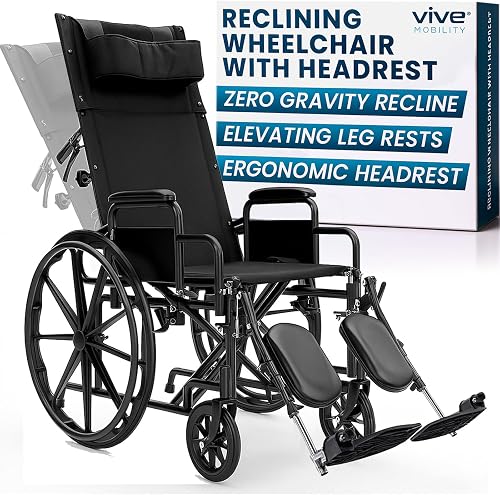
Vive Mobility Reclining Wheelchair with Elevating Leg
9.3/10 our score
See it on Amazon
- 4
 Check it
WEYRAL Reclining Wheelchair for Adults
Best for foldable travel use - 5
 Check it
Graham-Field Everest & Jennings Advantage Reclining Wheelchair
Best for larger users - 6
 Check it
McKesson Reclining Wheelchair & Detachable Desk Arms
Best for detachable desk arms - 7
 Check it
VERPAL Reclining Electric Wheelchair for Adult Foldable
Best electric option in this group
Our top reclining wheelchairs with elevating leg rests
These seven models cover the main choices in this category. Seat width ranges from 18 in to 22 in.
Recline ranges from 140 degrees to 180 degrees. Six are manual chairs and one is electric.
Use seat width and recline angle first, then compare arm and head support features.
Medline Reclining Wheelchair: Best for full recline and transfers
- Desk-length arms
- Elevating leg rests
- Reclines up to 180 degrees
- Breathable nylon upholstery
- Hammertone frame
- 300 lb weight capacity
- 20 x 18 in seat
A wide 20 in seat and full recline to 180 degrees suit adults who rest or nap in the chair and want desk-length arms for transfers.
Pros
- Widest recline range in this group
- 20 in seat for more room
- Desk-length arms help with transfers
Cons
- 66 lb package weight is heavy to lift
- No detachable headrest stated
This Medline suits adults who want a near flat rest position and a seat with extra width. Its 20 x 18 in seat gives more hip room than an 18 in model.
Recline goes up to 180 degrees in infinite positions, so you can stop at a lounge angle or go flatter for a nap.
Desk-length arms make transfers easier because you can push through them when moving to a bed or chair. Elevating leg rests support the legs when reclined and move out of the way for transfers.
Breathable nylon upholstery wipes clean, which helps in daily use at home.
A hammertone frame supports up to 300 lb. That limit suits most adults, but check your weight plus any clothing or bag you carry.
The package weight is 66 lb, so plan for help when lifting it into a car.
Choose this over the 18 in Medline if you value width and full recline. Choose the Everest & Jennings instead if you need a 22 in seat or a 450 lb limit.
Medline Reclining Wheelchair: Best for a narrower 18 in seat
- 18 x 18 in seat
- Reclines 90 to 140 degrees
- Swing-away elevating leg rests
- 10 in removable headrest
- 22 in high seatback
- 300 lb weight limit
- Carbon steel frame
An 18 in seat with a tall back and removable headrest suits smaller frames and tighter doorways than the 20 in and 22 in models.
Pros
- Narrower seat for tighter spaces
- Removable headrest included
- Anti-tippers and locking brakes included
Cons
- Recline stops at 140 degrees
- Less seat width for larger users
This 18 in Medline suits smaller adults and homes with narrower doorways. Its 18 x 18 in seat leaves less room than a 20 in seat, but it fits through tighter gaps.
Recline runs from 90 to 140 degrees through a hydraulic mechanism with quick adjust handles.
A 22 in high seatback with a 10 in removable headrest gives full back and head support when reclined. That matters at 140 degrees, where your head needs support rather than hanging back.
Swing-away elevating leg rests have plastic foot plates and move aside for transfers.
The carbon steel frame has a silver vein finish and supports 300 lb. Wheels sit back on the frame to help prevent tipping, and anti-tippers and locking brakes come with the chair.
Composite mag style wheels suit foot aided propulsion.
Choose this if an 18 in seat fits your frame and doorways. Choose the wider Medline if you want to recline past 140 degrees.
Vive Mobility Reclining Wheelchair with Elevating Leg: Best for head and neck support
- Reclines to 180 degrees
- Dual calf pads on leg rests
- Integrated headrest
- Detachable cervical cushion
- Reinforced steel frame
- 300 lb support
- 24 in rear wheels and 8 in front casters
Full recline plus an integrated headrest and detachable cervical cushion suit long seated sessions where neck support matters.
Pros
- True 180 degree recline
- Calf pads on elevating leg rests
- Locking rear brakes
Cons
- Seat width not stated in the data
- 60 lb product weight
This Vive Mobility chair suits people who sit for long stretches and need neck support. It reclines to a true 180 degrees and locks at multiple angles.
That lock matters, because a chair that drifts while you rest can feel unsafe.
Elevating leg rests have dual calf pads and swing away for transfers. Height adjustment lets you set the foot plates to your leg length.
Vive says the leg rests promote circulation, so treat that as a comfort claim and focus on the fit and support you feel.
An integrated headrest plus a detachable cervical cushion support spinal alignment while reclined. Padded armrests and a reinforced backrest add comfort for home or clinic use.
A reinforced steel frame supports 300 lb.
Large 24 in rear wheels and 8 in front casters roll over indoor floors and outdoor paths. Locking rear brakes help during transfers.
At 60 lb, this chair is lighter than the Medline package weight, but still needs help to lift.
WEYRAL Reclining Wheelchair for Adults: Best for foldable travel use
- Backrest adjusts 90 to 180 degrees
- Swing-away elevating leg rests
- Flip-back arms
- High back with removable headrest
- 18.5 in seat width
- 265 lb support
- 20 in solid rear wheels
A foldable 18.5 in chair with flip-back arms and a removable headrest suits travel and tight turns in indoor spaces.
Pros
- Foldable design
- Flip-back arms for transfers
- Solid puncture-free tires stated
Cons
- 265 lb limit is lower than most picks
- Traction claims need careful real-world checks
This WEYRAL chair suits travel and indoor use where folding matters. Its backrest adjusts from 90 to 180 degrees and has a headrest with adjustable height and angle.
You can sit upright for meals, then recline for rest without changing chairs.
Swing-away elevating leg rests and flip-back arms help with transfers. Flip-back arms swing back so a caregiver can assist from the side.
Desk length arms on other models push for transfers, while flip-back arms open the side for help.
The seat is 18.5 in wide and supports 265 lb. That limit is lower than the 300 lb limit on most picks, so check the weight carefully.
A soft breathable seat cushion has a seat belt and can be removed and washed.
Solid puncture free tires and a small turning radius suit tight indoor turns. WEYRAL describes use on grass, slopes and rough roads.
Treat terrain claims with care and test on smooth paths first, because stability changes when reclined.
Graham-Field Everest & Jennings Advantage Reclining Wheelchair: Best for larger users
- 22 x 19 in seat
- Reclines 90 to 170 degrees
- Elevating legrests
- Desk-length armrests
- Removable headrest
- 450 lb seat support
- Rear anti-tippers
- Anti-fold spreader bar
A 22 in seat rated to 450 lb with a 170 degree recline suits larger adults who need more room than an 18 in or 20 in seat gives.
Pros
- Highest weight capacity here
- Wide 22 in seat
- Anti-tippers and spreader bar
Cons
- Widest seat needs wider doorways
- Recline stops at 170 degrees
This Everest & Jennings chair suits larger adults who find 18 in and 20 in seats too narrow. Its 22 x 19 in seat supports up to 450 lb.
That extra width and depth help with clothing, positioning aids and longer legs.
The high back reclines from 90 to 170 degrees. You get a deep lounge angle, though not the full 180 degrees of the Medline and Vive models.
A removable headrest cradles the head and neck for long use.
Elevating legrests and desk length armrests add comfort and help with transfers. Rear anti-tippers and an anti-fold spreader bar keep the chair steady when reclined.
The spreader bar also stops the frame from folding while you sit.
At 51.3 lb, this is the lightest manual chair in this group by listed item weight. It folds for transport and fits in most car trunks, according to Graham-Field.
The wide seat still needs wider doorways, so measure before you buy.
McKesson Reclining Wheelchair & Detachable Desk Arms: Best for detachable desk arms
- 18 in seat width
- Detachable padded desk arms
- Hydraulic reclining mechanism
- Infinite adjustments up to 180 degrees
- Swing-away elevating footrests with metal footplates
- Carbon steel frame with silver vein finish
- Nylon upholstery
- 300 lb capacity
Detachable padded desk arms and a hydraulic recline to 180 degrees suit users who transfer from the side or work at a desk height surface.
Pros
- Detachable desk arms
- Hydraulic infinite recline
- 60 lb product weight
Cons
- Limited spec detail in the data
- 16 in seat depth is shallower than others
This McKesson chair suits users who want detachable desk arms. Its detachable padded desk arms come off for side transfers and for pulling close to a table.
That differs from fixed arms, where you must use the arm height as given.
A hydraulic reclining mechanism gives infinite adjustments up to 180 degrees. You can lock in a position for reading, rest or a nap.
Swing-away elevating footrests have metal foot plates and move aside for transfers.
The chair has an 18 in seat width and a 16 in seat depth. A shallower depth suits shorter legs, but taller users may want more thigh support.
Carbon steel frame with a silver vein finish and nylon upholstery keep cleaning simple.
McKesson lists a 300 lb capacity and a product weight of 60 lb. Urethane tires on composite wheels suit most indoor and outdoor surfaces.
Check the exact seat width at checkout, because the data refers to 18 in and 20 in versions.
VERPAL Reclining Electric Wheelchair for Adult Foldable: Best electric option in this group
- Electric drive, 500W
- 20Ah battery, 15 miles stated
- Backrest adjusts 90 to 160 degrees
- Detachable headrest
- 90 degree rotatable footrest
- 16 in aluminum wheels
- 5 speed settings
- USB charging port
- LED lights
An electric foldable model with a 90 to 160 degree backrest suits adults who want powered movement and a footrest that rotates for transfers.
Pros
- Only powered model here
- Foldable for trunk storage stated
- Rotatable footrest for transfers
Cons
- 105 lb weight needs two people to lift
- Recline stops at 160 degrees
This VERPAL chair is the only electric model here, so it suits a different buyer. It runs on electric power with a 500W motor and a 20Ah battery rated for 15 miles.
Powered movement helps if pushing a manual chair for long distances wears you out.
The backrest adjusts from 90 to 160 degrees for sitting, lounging and lying flatter for rest. A detachable headrest supports the head when reclined.
The footrest rotates 90 degrees and adjusts in height, which helps with transfers.
Extra wide cushioned armrests support natural posture. Five speed settings let you start slow in tight spaces.
A USB charging port powers a phone, and LED lights help with visibility at night.
At 105 lb, this chair needs two adults to lift into a trunk. VERPAL says it fits most standard trunks, but plan for help.
Choose electric for powered movement. Choose a manual chair if you want a lighter frame and simpler maintenance.
Best reclining wheelchair with elevating leg rests: side by side
The table below compares seat width, recline range and weight limit. Those three specs decide fit for most buyers.
Arm style and head support then decide daily comfort.
| Product | Best for | Seat width | Seat depth | Weight capacity | Our score |
|---|---|---|---|---|---|
| Medline Reclining Wheelchair | full recline and transfers | 20 in | 18 in | 300 lb | 9.7 |
| Medline Reclining Wheelchair | a narrower 18 in seat | 18 in | 18 in | 300 lb | 9.6 |
| Vive Mobility Reclining Wheelchair with Elevating Leg | head and neck support | 300 lb | 9.3 | ||
| WEYRAL Reclining Wheelchair for Adults | foldable travel use | 18.5 in | 265 lb | 9.1 | |
| Graham-Field Everest & Jennings Advantage Reclining Wheelchair | larger users | 22 in | 19 in | 450 lb | 8.8 |
| McKesson Reclining Wheelchair & Detachable Desk Arms | detachable desk arms | 18 in | 16 in | 300 lb | 8.5 |
| VERPAL Reclining Electric Wheelchair for Adult Foldable | electric option in this group | 8.2 |
How we compared these reclining wheelchairs
We checked each model's seat width and depth against the space most adults need. We compared recline range first, because 140 degrees and 180 degrees feel very different for rest.
We then checked weight limits, since a chair rated to 265 lb suits fewer buyers than one rated to 300 lb or 450 lb.
We looked at arm style next. Desk length arms help you push during transfers.
Detachable arms come off for side help. Flip-back arms swing back for a caregiver.
Each style suits a different transfer method.
Head support matters when you recline past 120 degrees. Some chairs include a removable headrest.
The Vive model adds a detachable cervical cushion. Chairs without head support can leave your neck unsupported at a deep angle.
We also checked safety parts. Anti-tippers reduce backward tipping when reclined.
Locking brakes hold the chair still for transfers. A spreader bar keeps the frame from folding under load.
We gave higher scores to chairs that include more of these parts and cover more seat sizes.
What recline angle do you actually need?
Choose 180 degrees if you nap or rest flat in the chair. Full recline suits long rest periods and position changes.
The Medline B08KYFKY22, Vive and McKesson models reach 180 degrees.
Choose 140 to 160 degrees if you lounge while awake. The 18 in Medline stops at 140 degrees.
The VERPAL electric model stops at 160 degrees.
A partial recline keeps you more upright for reading, meals and conversation.
Full recline for rest
Full recline to 180 degrees suits people who rest for an hour or more. It also helps with pressure relief through position changes.
Pair full recline with a headrest, because your head supports your body weight at a flat angle.
Partial recline for daily use
Partial recline suits short breaks and daytime sitting. You stay close to upright, so transfers in and out take less effort.
This angle also keeps the chair more stable on slopes.
A reclining wheelchair with head support suits deep recline best, because head support stops your neck from bending back. If you plan to recline past 140 degrees, treat head support as a must, not an extra.
How wide should the seat be?
Measure your hips in your usual clothing, then add 2 in for shifting. An 18 in seat suits smaller frames and narrow doorways.
A 20 in seat suits most adults.
A 22 in seat suits larger users.
18 in seats for smaller frames
An 18 in seat fits through standard doorways more easily. The Medline B08KYK7C2R and McKesson models use this width.
Check seat depth too, because 16 in and 18 in depths suit different leg lengths.
20 in and 22 in seats for more room
A 20 in seat gives more room to shift and to wear thicker clothing. A 22 in seat gives the most room and pairs with the highest weight limit here.
Our guide to a light weight reclining wheelchair helps if you also worry about lifting the chair.
Which arm style helps with transfers?
Desk length arms help you push down during a transfer. Fixed desk arms on the Medline and Everest & Jennings models give a firm push point.
That suits a stand pivot transfer where you push through your arms.
Detachable and flip-back arms for side help
Detachable arms come off for a caregiver to assist from the side. Flip-back arms swing back for the same purpose.
The McKesson model has detachable padded desk arms. The WEYRAL model has flip-back arms.
Choose detachable or flip-back arms if a helper does most of the transfer work. Choose fixed desk arms if you push through your own arms to stand.
Manual or electric: which fits your needs?
Choose manual if you want a lighter, simpler chair you can repair anywhere. Manual recline uses a hydraulic or manual mechanism with no battery.
Six models here work this way.
Choose electric if you want powered movement for longer trips. The VERPAL model uses a 500W motor and a 20Ah battery.
Powered drive helps on ramps and long indoor routes.
When manual makes more sense
Manual chairs weigh less and cost less to maintain. The Everest & Jennings model lists 51.3 lb.
Manual chairs also have no battery to charge or replace. They suit home use and short outings where someone can push.
When electric makes more sense
Electric chairs suit independent travel over longer distances. Speed settings help in tight spaces.
A foldable electric design fits in a trunk, but lifting 105 lb needs two people.
If you are unsure about power, our primer on a reclining electric wheelchair explains the trade-offs in plain terms.
What safety checks matter before you recline?
Lock the brakes and check anti-tippers before every transfer. Recline shifts your weight backward.
Anti-tippers stop the chair from tipping back.
Locking brakes stop the wheels from rolling during a transfer.
Brakes, anti-tippers and spreader bars
Locking rear brakes appear on the Medline, Vive and other models here. Rear anti-tippers appear on the Medline, Everest & Jennings and VERPAL models.
An anti-fold spreader bar on the Everest & Jennings model stops the frame from folding under load.
Safe use on slopes and uneven ground
Keep the back upright on slopes and uneven ground. Recline only on flat, firm surfaces.
Solid tires help with punctures, but they do not make rough ground safe when reclined.
A chair with elevating leg rests and a high back also raises your center of gravity when reclined. That is why the safety parts above matter more on a reclining chair than on a standard chair.
How do reclining chairs compare with tilt in space chairs?
A reclining chair changes the back angle. A tilt in space chair tilts the whole seat.
Recline bends at the hips and changes your posture.
Tilt keeps your hip angle the same and moves your center of gravity.
When recline is enough
Recline suits rest, naps and position changes for most adults. It also suits people who self propel and want to adjust toward a flat position.
Most chairs in this group use recline.
When tilt may suit you better
Tilt suits people who need postural support that recline cannot give. It also suits long hours where a fixed hip angle matters.
Our guide What Is a Tilt in Space Wheelchair? What Matters Most explains the key differences.
A transport chair with elevating leg rests takes a different approach again, because it targets shorter trips and caregiver pushing. Our list of best transport chair with elevating leg rest covers that option.
How to set up and care for a reclining wheelchair
Set the leg rests, brakes and recline lock before you sit down. Adjust the foot plates to your leg length with your heels supported.
Lock the brakes, then recline slowly and lock the back at your chosen angle.
Daily checks
Check tire pressure or tire condition, brake function and recline locks each week. Wipe nylon upholstery with a damp cloth.
Dry the frame after use in rain, because steel frames can rust at joints.
Cleaning and storage
Remove washable cushions where fitted and wash them by hand. Fold the chair by the maker's steps and store it dry.
Keep the recline mechanism free of grit, because dirt makes locks stiff.
Verdict: which reclining wheelchair with elevating leg rests should you buy?
Buy the Medline B08KYFKY22 if you want full recline and a 20 in seat. It covers the most common needs in one chair.
Buy the 18 in Medline B08KYK7C2R if you need a narrower seat and tall back support. Buy the Everest & Jennings if you need a 22 in seat and a 450 lb limit.
Our roundup of best reclining wheelchairs for adults covers more manual models if you want more choices. Start with seat width, then recline angle, then arm style.
Those three choices decide fit more than any other feature on this list.
Our top 3 picks at a glance
-
1
-
2
-
3
Best for head and neck support
Vive Mobility Reclining Wheelchair with Elevating Leg
9.3/10 our score
See it on Amazon
Frequently asked questions
How far should a reclining wheelchair recline?
It depends on how you rest. Some chairs recline to 180 degrees for a near flat position.
Others stop at 140 to 170 degrees for a supported lounge angle.
Match the angle to your use, and check head support at that angle.
What seat width should I choose?
Measure your hips in your usual clothing, then add room to shift. An 18 in seat suits smaller frames.
A 20 in seat gives more room.
A 22 in seat suits larger users and needs wider doorways.
Do elevating leg rests help with transfers?
Swing-away leg rests move to the side so your feet can reach the floor. That helps with side transfers to a bed or chair.
Desk length arms also help, because you can push down through them during a transfer.
Is a reclining wheelchair the same as a tilt in space wheelchair?
No. A reclining chair changes the back angle relative to the seat.
A tilt in space chair tilts the whole seat and keeps the hip angle the same.
Each type suits different postural needs.
Can a reclining wheelchair go over rough ground?
Large rear wheels and solid tires help on smooth outdoor paths. Rough ground still needs care, especially when reclined.
Keep the chair upright for slopes and uneven surfaces, and use anti tippers where fitted.