8 Best Wheelchair Adjustable Headrests (November 2026)
The best wheelchair adjustable headrests include the Medline Comfortable Folding Wheelchair for everyday manual use, the Vive Wheelchair Seatbelt for seated-position support, and the Medline Reclining Wheelchair for built-in reclining support.
On this page (6 sections)
- Which wheelchair adjustable headrest is best?
- How do you choose a wheelchair headrest attachment?
- Is a built-in or separate wheelchair headrest better?
- How should you set up and care for an adjustable wheelchair headrest?
- Can a wheelchair seatbelt replace a headrest?
- Final choice for the best wheelchair adjustable headrest
The best wheelchair adjustable headrest for a rigid-back chair is the Rehabilitation Advantage Wheelchair Headrest Support System. It offers height, depth and angle adjustment, while reclining wheelchairs from Medline and Vive provide head support as part of the chair.
That split is the core choice in this guide. A separate attachment suits a chair you already own, while a built-in headrest moves with a reclining backrest.
An adjustable headrest must match the chair frame, backrest design and mounting space. Check whether your wheelchair has a rigid solid back, then measure the back width, clamp area and the seated head position before choosing an attachment.
Measurements matter because a pad set too high or too far back may offer little real support. A pad set too close may also make the seated position feel cramped or tip the head forward.
Our score weighs the stated specs, useful features and fit for the best wheelchair adjustable headrest search. We compared adjustable mounting hardware, built-in head support, reclining range, portability and the trade-offs between manual, transport and powered chairs.
Those trade-offs shape daily use more than a single feature. Weight affects lifting and storage, while recline range affects rest and transfers.
A transport chair can be easier to carry but may not accept a clamp system. A reclining chair can support the head while the back moves but often weighs more.
A powered chair adds travel freedom and charging needs. A manual chair keeps setup simpler and avoids battery care.
This guide keeps those distinctions clear so the headrest choice matches the chair and the person using it. The right pick depends on backrest type, mounting space and how support must change through the day.
Our picks at a glance
-
1
 Best for everyday manual use
Medline Comfortable Folding Wheelchair
9.7/10 our score
See it on Amazon -
2
-
3

- 4
 Check it
Vive Mobility Reclining Wheelchair with Elevating Leg
Best for full recline - 5
 Check it
VERPAL Reclining Electric Wheelchair for Adults
Best for powered outdoor travel - 6
 Check it
WEYRAL Super Lightweight Portable Transit Travel Wheelchair
Best for lightweight travel - 7
 Check it
Rehabilitation Advantage Wheelchair Headrest Support System
Best for adjustable rigid-back mounting - 8
 Check it
Medorol Transport Wheelchairs for Adults Lightweight Foldable
Best for compact transfers
Which wheelchair adjustable headrest is best?
The Rehabilitation Advantage system is the strongest choice when you already have a wheelchair with a rigid solid back rest. It has a small curved memory foam pad, a standard clamp and multi-axis hardware for height, depth and angle changes.
A reclining wheelchair is a better fit when the headrest must move with the back angle. The Medline Reclining Wheelchair includes a removable 10 in headrest, while the Vive Mobility chair includes an integrated headrest and detachable cervical cushion.
| Product | Best for | Seat | Overall width | Weight | Our score |
|---|---|---|---|---|---|
| Medline Comfortable Folding Wheelchair | everyday manual use | 18 W x 16 D in | 26.5 in | 38 lb | 9.7 |
| Vive Wheelchair Seatbelt | seated-position support | 9.6 | |||
| Medline Reclining Wheelchair | built-in reclining support | 16 W x 18 D in | 61.9 lb | 9.3 | |
| Vive Mobility Reclining Wheelchair with Elevating Leg | full recline | 9.3 | |||
| VERPAL Reclining Electric Wheelchair for Adults | powered outdoor travel | 8.8 | |||
| WEYRAL Super Lightweight Portable Transit Travel Wheelchair | lightweight travel | 26.7 lb | 8.3 | ||
| Rehabilitation Advantage Wheelchair Headrest Support System | adjustable rigid-back mounting | 8.0 | |||
| Medorol Transport Wheelchairs for Adults Lightweight Foldable | compact transfers | 7.8 |
Medline Comfortable Folding Wheelchair: Best for everyday manual use
- 18 x 16 in seat
- 300 lb capacity
- Swing-back desk-length arms
- Elevating leg rests
A foldable manual wheelchair with an 18 x 16 in seat, swing-back desk-length arms and elevating leg rests. Its rigid frame can be a starting point for checking a separate headrest attachment.
Pros
- 300 lb capacity
- Breathable nylon upholstery
- Folds to 11.5 in wide
Cons
- Headrest attachment is not included
- Not a reclining wheelchair
The Medline Comfortable Folding Wheelchair suits everyday manual use when you need a foldable chair with an 18 x 16 in seat. Its swing-back, desk-length arms can make lateral transfers and table access easier, while elevating leg rests add positioning options.
The hammertone frame weighs 38 lb and supports up to 300 lb. Large wheels and smooth-rolling tires are intended for indoor and outdoor use, while the brake system locks the chair in place.
This chair does not include a headrest. Before adding a wheelchair headrest attachment, check that the back and frame provide a suitable mounting area.
The 26.5 in overall width also matters when you measure doorways or compare mounting clearance.
Choose it when the chair itself is the priority and you want to add head support later. For protection from dirt and wear after installation, compare our guide to the best wheelchair headrest cover.
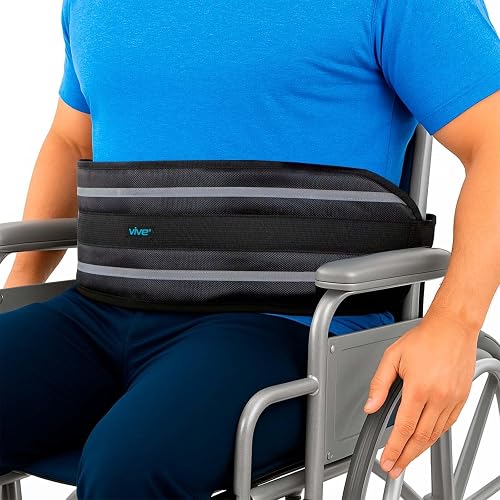
Vive Wheelchair Seatbelt: Best for seated-position support
- Adjustable padded belt
- 37 to 75 in combined fit
- Reflective strips
- Reinforced stitching
This is a torso-support belt rather than a headrest. It can help keep a seated user from slipping or slouching, but it does not replace adjustable head support.
Pros
- Wide belt distributes pressure
- Adjusts around user and backrest
- Reflective strips
Cons
- Does not support the head
- Fit requires measuring user and chair together
The Vive Wheelchair Seatbelt is for torso support, not head support. Its wide, lightly padded belt wraps around the seated user and the wheelchair backrest to help reduce slipping or slouching.
The combined user and chair-frame measurement must be between 37 and 75 in at the belt placement height. That two part measurement is easy to get wrong, so check it with the user seated and the belt placed where it will actually sit.
Reinforced stitching, reflective strips and adjustable padding are useful details for users who need a more secure seated position. The wide design spreads pressure across the midsection rather than concentrating it in a narrow band.
For daily use, set the belt before a transfer or a longer seated period and recheck it after the user settles into the chair. A belt that shifts as posture changes may need readjusting, and skin should be checked where padding sits over time.
A seatbelt cannot replace a wheelchair adjustable headrest. It may work alongside head support when the user needs help staying positioned, but measure carefully and follow safe transfer practices.
Choose it when seated-position support is part of the problem. Do not choose it as the only solution for a user who needs direct neck or head support.
Medline Reclining Wheelchair: Best for built-in reclining support
- 90 to 140 degree recline
- 10 in removable headrest
- 16 x 18 in seat
- Elevating leg rests
The built-in 10 in headrest extension and cushioned head immobilizer suit users who need head support while reclining. Its hydraulic mechanism adjusts from 90 to 140 degrees.
Pros
- Removable headrest
- Head support extension for recline
- Rear anti-tippers
Cons
- Heavier than the folding manual pick
- Seat is 16 in wide
The Medline Reclining Wheelchair is the best match here for built-in head support with a manual reclining chair. Its hydraulic mechanism adjusts from 90 to 140 degrees, and the 10 in headrest extension is removable.
The cushioned head immobilizer and support extension are designed for the reclining position. That matters during rest periods, when the head needs support at an angle rather than only when upright.
Elevating leg rests, padded armrests and nylon upholstery add comfort features, while rear anti-tippers and locking wheel brakes address stationary use. Nylon upholstery is also easier to wipe clean than a more absorbent fabric.
At 61.9 lb, it is much heavier than a basic folding wheelchair. That weight affects lifting into a vehicle, storage and pushing over longer distances.
The 16 in seat width and 24.5 in overall width should be checked against the user’s fit and the spaces where the chair will be used. A narrow seat can suit some users and feel tight for others.
Choose it when recline and built-in head support matter more than low carry weight. For a manual chair without this integrated design, compare our best manual wheelchair headrest guide.
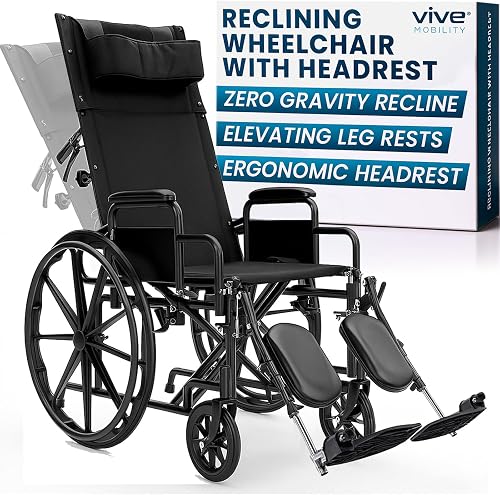
Vive Mobility Reclining Wheelchair with Elevating Leg: Best for full recline
- 180 degree recline
- Integrated headrest
- Detachable cervical cushion
- 300 lb capacity
This heavy-duty reclining wheelchair combines an integrated headrest with a detachable cervical cushion. It reclines fully to 180 degrees and includes elevating, height-adjustable leg rests.
Pros
- Full recline
- Head and neck support
- Locking rear brakes
Cons
- 60 lb chair weight
- Large 50 x 27 x 48 in dimensions
The Vive Mobility Reclining Wheelchair is the best choice for full recline and built-in neck support. It reclines to 180 degrees, locks at multiple angles and includes an integrated headrest with a detachable cervical cushion.
Its elevating leg rests have dual calf pads and height adjustment. Raising the legs while reclined can reduce pressure in the lower limbs during long seated periods.
The reinforced steel frame supports up to 300 lb, while 24 in rear wheels, 8 in front casters and locking rear brakes support movement and transfers. The larger rear wheels are better suited to covering ground than small casters alone.
This chair measures 50 x 27 x 48 in and weighs 60 lb. Those dimensions make it a poor match for tight storage areas, even though the full recline can suit long seated periods or rest.
Set up the recline locks before the user leans back, and check that the headrest and cervical cushion stay aligned at the angles you plan to use. A full recline also changes transfer needs, so plan for help or a clear clear space beside the chair.
Choose it when you need the chair and head support to change position together. If you need side-to-side trunk guidance as well, read how to choose a wheelchair headrest with lateral support.
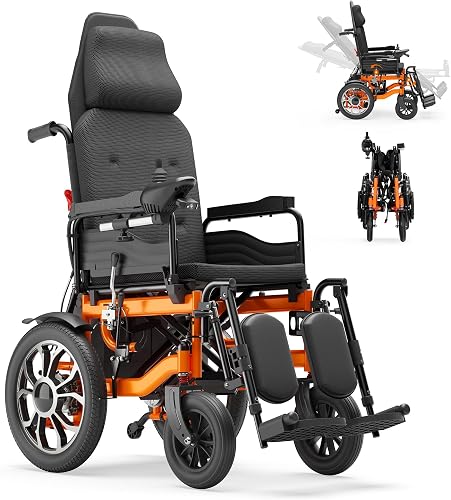
VERPAL Reclining Electric Wheelchair for Adults: Best for powered outdoor travel
- 160 degree adjustable backrest
- Detachable headrest
- Dual 250 W motors
- 20 Ah battery
The detachable headrest works with a powered chair whose backrest adjusts to 160 degrees. Dual 250 W motors, 5 speed settings and a 360 degree joystick suit users seeking powered movement.
Pros
- Detachable headrest
- Left or right controller mounting
- Quick-release battery
Cons
- Headrest dimensions are not stated
- Powered chair needs charging
The VERPAL Reclining Electric Wheelchair suits users who want powered movement with a detachable headrest and an adjustable backrest. The backrest reclines to 160 degrees, and the controller can be mounted on the left or right.
Dual 250 W motors, 5 speed settings and a 360 degree joystick are intended for indoor and outdoor movement. Lower speeds suit tight indoor spaces, while higher settings suit open outdoor areas.
The 20 Ah quick-release battery provides a stated range of up to 15 miles and a maximum speed of 3.7 mph. A removable battery also makes charging simpler where the chair is stored away from an outlet.
The chair also has a swing-up footrest, automatic and manual braking, LED headlights and a USB port. The footrest swing can help with transfers, and automatic braking helps hold the chair on an incline when the controller is released.
Its detachable headrest is useful, but the headrest dimensions and mounting details should be confirmed before ordering. Powered does not mean every accessory fits every frame.
Choose it when powered travel and reclined positioning are both important. Choose a manual attachment instead when you already have a suitable chair and do not need a motor.
WEYRAL Super Lightweight Portable Transit Travel Wheelchair: Best for lightweight travel
- 26.7 lb weight
- Telescopic handle
- Travel bag
- Seat belt
This portable transit chair weighs 26.7 lb and folds with a telescopic handle and travel bag. It is useful for transport, but confirm the backrest and clamp dimensions before adding a headrest.
Pros
- Lightweight frame
- Folds for car travel
- Small turning radius
Cons
- Headrest is not included
- Compatibility needs measurement
The WEYRAL Super Lightweight Portable Transit Travel Wheelchair is the best fit for users who carry a chair often. Its aluminum alloy frame weighs 26.7 lb, folds for a car trunk and comes with a telescopic handle and travel bag.
The 11 in rear honeycomb wheels use a spring damping system, and the chair includes a seat belt and integrated handbrake. The damping system is meant to soften bumps during short trips and transfers.
The small turning radius helps in tight doorways, while the frame is described for grass, slopes, sand, mud, snow and rough roads. Treat rough ground as a short trip use case and check conditions before choosing a route.
This transport chair does not include a headrest. A separate wheelchair headrest attachment must match the backrest and frame, so measure before choosing a clamp system.
For care, fold and unfold the chair on a flat surface and check that the handbrake holds before the user sits. Keep the travel bag clean and dry so the folded chair stays easier to store in a trunk.
Choose it when low carry weight matters most. A heavier reclining chair may be a better fit when the user needs built-in head support during long seated periods.
Rehabilitation Advantage Wheelchair Headrest Support System: Best for adjustable rigid-back mounting
- Height, depth and angle adjustment
- Small 9 x 5 x 2 in pad
- Standard clamp
- Memory foam pad
This is the clearest match for an adjustable wheelchair headrest attachment. The multi-axis hardware adjusts height, depth and angle, and the pivoting ball joint allows off-center positioning.
Pros
- Multi-axis adjustment
- Machine-washable neoprene cover
- Includes clamp and hardware
Cons
- Small pad size
- Arrives unassembled
The Rehabilitation Advantage Wheelchair Headrest Support System is the best adjustable wheelchair headrest attachment in this group. It attaches to most wheelchairs with a rigid solid back rest and adjusts in height, depth and angle.
The small curved pad measures 9 in wide, 5 in high and 2 in thick. That compact size suits users who need light contact behind the head rather than a broad support surface.
Its soft memory foam has a machine-washable neoprene cover, while the metal multi-axis hardware includes a standard clamp and pivoting ball joint for off-center positioning. Off-center placement can help when a user’s seated posture is not perfectly centered.
The system arrives unassembled. The pad mounts to the horizontal bar with the included 3 bolts, then the hardware mounts to the wheelchair with its clamp.
That assembly step takes time and needs the bolts snug before use. Check the chair’s rigid-back design and mounting space before installation, and test the pad position with the user seated.
Choose it when you want a separate wheelchair headrest attachment with several adjustment directions. Choose a built-in reclining chair when you need the headrest to move with the backrest.
Medorol Transport Wheelchairs for Adults Lightweight Foldable: Best for compact transfers
- 21 lb chair claim
- 3-second folding
- Telescopic handle
- Height-adjustable backrest
The compact transport chair has a height-adjustable backrest, flip-up armrests and footrests, and a telescopic handle. Measure the back before pairing it with a separate headrest attachment.
Pros
- Compact folding design
- Height-adjustable backrest
- Brake and parking modes
Cons
- Headrest is not included
- Published chair weight differs between title and package data
The Medorol Transport Wheelchair suits compact transfers and travel. It folds in 3 seconds, has a telescopic handle and includes a height-adjustable backrest, flip-up armrests and footrests, and a mesh breathable seat and back cushion.
Its aluminum alloy frame, 360 degree front wheels and shock-absorbing springs are intended for maneuvering in tight spaces. Front wheel rotation helps with turning in hallways and around furniture.
Brake and parking modes provide separate ways to control the chair while moving or stopped. Use the parking mode before a transfer so the chair does not roll as weight shifts.
The chair does not include a headrest. Its height-adjustable backrest may help with positioning, but it does not confirm compatibility with a separate clamp or support bar.
For daily care, keep the mesh seat and back cushion clean and check the flip-up parts for smooth movement. A height-adjustable backrest still needs the mounting area measured before adding any attachment.
Choose it when compact folding and transfer use matter more than built-in head support. Check the backrest shape and mounting area before pairing it with an attachment.
How do you choose a wheelchair headrest attachment?
Choose a wheelchair headrest attachment by checking the backrest type, mounting dimensions, adjustment directions and pad size. A rigid solid back is especially important for the Rehabilitation Advantage clamp system.
Measure these points while the user is seated:
- The width and height of the backrest.
- The available clamp area.
- The distance from the backrest to the back of the head.
- The desired headrest height.
- Whether the user needs centered or off-center support.
- Whether the headrest must move as the chair reclines.
A wheelchair headrest adjustable in height may solve a different problem from one adjustable in depth. Height changes the contact point, depth changes how far the pad sits behind the head, and angle changes the pad’s contact position.
Do not assume that a transport chair, folding chair or powered chair accepts the same attachment. The frame, backrest and clamp area must match the attachment’s mounting design.
Is a built-in or separate wheelchair headrest better?
A built-in headrest is usually better when you need the support to follow a reclining backrest. As the back angle changes, the head position changes with it.
A separate wheelchair headrest attachment is more flexible when you already own a rigid-back chair and need to adjust the pad independently. Height, depth and angle can be set without changing the whole chair.
The Medline Reclining Wheelchair has a removable 10 in headrest extension and reclines from 90 to 140 degrees. Its support is designed for that reclining range rather than for a fixed upright seat.
The Vive Mobility chair reclines to 180 degrees and combines an integrated headrest with a detachable cervical cushion. That design suits users who need rest positions and neck support in the same system.
A separate system gives you more control over height, depth and angle. It also adds a setup step and requires careful checking of the chair’s rigid back and clamp dimensions.
Built-in support can feel simpler once the chair is set up, but the pad options may be limited to what the chair offers. Separate hardware can be moved or readjusted, yet it must be checked whenever the chair or posture changes.
Cost is another factor, since a new reclining chair is a larger purchase than an attachment alone. If your current chair has a suitable rigid back, an attachment may be the more practical first step.
Choose built-in support when recline and head support must work together. Choose separate adjustment when a rigid-back chair already meets the rest of your needs.
How should you set up and care for an adjustable wheelchair headrest?
Set up the headrest with the wheelchair stationary on a level surface, then check the pad position while the user is seated in their normal posture. A level surface gives a truer read of height and depth than setup on a slope.
Tighten the hardware according to its instructions and confirm that the clamp and pad stay in place during ordinary repositioning. Small shifts at the clamp can change pad position more than they first appear to.
The Rehabilitation Advantage pad has a machine-washable neoprene cover. Remove dirt from the cover and inspect the clamp, bolts and pivot points regularly.
Washing the cover on schedule keeps the pad cleaner for repeated contact with the head and neck area. Inspecting bolts and pivot points helps catch looseness before the pad starts to move during use.
Do not use a loose or shifting headrest until its hardware has been checked. A pad that slides under load may not support the head when it is needed most.
If the chair reclines, confirm that the headrest remains in a useful position through the full range you plan to use. A headrest that fits upright may not provide the same support when the back angle changes.
Recheck the setup after the user has been seated for a while, not only at the moment of fitting. Posture often settles, and the pad may need a small change in depth or angle.
Can a wheelchair seatbelt replace a headrest?
No. A wheelchair seatbelt supports the torso and helps reduce slipping or slouching, while a headrest supports the head and neck area.
The Vive Wheelchair Seatbelt fits a combined user and chair-frame circumference of 37 to 75 in. That range covers the user and the chair back together, not the user alone.
Use each accessory for its intended role and check the fit while the user is seated. A belt that fits over clothing may sit differently once the user is fully settled.
A seatbelt can work with a headrest when both torso position and head support are needed. It should not be used to hold the head in place or to replace direct head support.
Check the belt for skin comfort, ease of release and clear access for transfers. Padding should distribute pressure without cutting into the ribs or hips.
If you are unsure about positioning, transfers or ongoing neck discomfort, ask a qualified health professional for guidance. Fit is best judged with the user seated in the chair they use each day.
Final choice for the best wheelchair adjustable headrest
Pick the Rehabilitation Advantage system if you have a rigid solid-back wheelchair and need height, depth and angle adjustment. It is the clearest separate attachment choice in this group.
Pick the Medline Reclining Wheelchair for a manual chair with a built-in removable headrest, or the Vive Mobility chair for full recline and integrated neck support. Both keep head support tied to the reclining backrest.
Choose the VERPAL for powered travel, the WEYRAL or Medorol for lighter transport, and the Vive seatbelt only when torso positioning is the specific need. Each chair solves a different part of the problem.
Before ordering any attachment, measure the backrest width and height, the clamp area and the distance from the backrest to the head. Those checks prevent a pad that cannot mount or cannot reach a useful position.
Also confirm whether the user needs centered or off-center support and whether the chair reclines. A headrest that works upright may not work through a recline range.
If you also need a surface for meals or activities, compare a best wheelchair tray attachment after confirming that it fits the chair and armrests. Keep the tray choice separate from the headrest choice so neither part is rushed.
The best wheelchair adjustable headrest is the one that mounts securely, fits the seated user and stays useful in daily use. Start with the chair you have, then match the support to its backrest design.
Our top 3 picks at a glance
-
1
Best for everyday manual use
Medline Comfortable Folding Wheelchair
9.7/10 our score
See it on Amazon -
2
-
3
Frequently asked questions
What is the best wheelchair adjustable headrest?
The Rehabilitation Advantage Wheelchair Headrest Support System is the strongest separate attachment here because it adjusts in height, depth and angle and attaches to most wheelchairs with a rigid solid back rest. A reclining wheelchair with an integrated headrest may be better when support must follow the back angle.
Will any headrest attachment fit any wheelchair?
No. Check the wheelchair’s backrest type, clamp area, frame dimensions and available space behind the user’s head.
The Rehabilitation Advantage system is designed for most wheelchairs with a rigid solid back rest, but you still need to measure the chair before ordering.
What measurements matter for a wheelchair headrest?
Measure the backrest width and height, the clamp area, the distance from the backrest to the head, and the desired pad height. Also check whether the user needs centered or off-center positioning and whether the chair reclines.
Is a wheelchair seatbelt the same as a headrest?
No. A seatbelt supports the torso and can help reduce slipping or slouching.
A headrest supports the head and neck area.
The Vive Wheelchair Seatbelt fits a combined user and chair-frame circumference from 37 to 75 in, but it does not replace head support.
Should I choose a built-in or separate wheelchair headrest?
Choose built-in support when the wheelchair reclines and the headrest needs to follow the back angle. Choose a separate attachment when you have a rigid-back chair and want independent height, depth and angle adjustment.


