9 Best Wheelchair Safety Straps and Belts (November 2026)
The best wheelchair safety straps include the NEPPT Wheelchair Seatbelt Restraints for Dementia Patients for fall prevention and sliding, the Vive Wheelchair Seatbelt for wide padded comfort, and the HEALTHLINE Wheelchair Strap Seat Belt for auto-style buckle use.
On this page (8 sections)
- Our picks for wheelchair safety straps for seniors and adults
- How to compare wheelchair safety straps by fit, adjustment and release
- How we compared these wheelchair safety straps
- What size wheelchair safety strap do I need?
- Which buckle is easiest for daily transfers?
- How do I install a wheelchair safety strap safely?
- Are wheelchair restraints for seniors safe to use at home?
- Which wheelchair safety strap should you buy?
The best wheelchair safety straps for most people start with the NEPPT, because it combines an adjustable waist fit, tool-free install and a quick-release buckle.
Good wheelchair restraints for elderly users should keep a person positioned without cutting into skin or making transfers harder.
Our score weighs specs, features and buyer feedback against what you're shopping for.
That includes fit range, buckle design, padding, mounting method and how clearly each belt states its limits.
Our picks at a glance
-
1
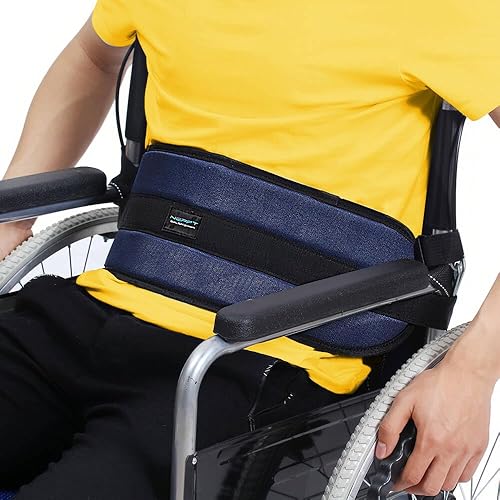 Best for fall prevention and sliding
NEPPT Wheelchair Seatbelt Restraints for Dementia Patients
9.7/10 our score
See it on Amazon -
2
-
3
 Best for auto-style buckle use
HEALTHLINE Wheelchair Strap Seat Belt
9.4/10 our score
See it on Amazon
- 4
 Best for vest-style upper body supportCheck it
- 5
 Check it
PSNOOK Adjustable Wheelchair Safety Strap Seat Belt
Best for wide adjustment range - 6
 Check it
DMI Wheelchair Seat Belt and Safety Harness
Best for screw-on backrest mounting - 7
 Check it
Secure Safety Solutions Wheelchair Solid Seat Insert
Best for sling seat posture support - 8
 Check it
AMPHIARAUS 200Inch Bed Restraint Strap Anti-Fall Waist
Best for extra-long tethering - 9
 Check it
HOONHERY Bed Restraint Strap for Elderly
Best for padded bed waist use
Our picks for wheelchair safety straps for seniors and adults
NEPPT leads this group for simple daily positioning and fall prevention.
The order below follows score, from highest to lowest, so you can see trade-offs as you scroll.
NEPPT Wheelchair Seatbelt Restraints for Dementia Patients: Best for fall prevention and sliding
- Adjustable waist strap
- Quick-release buckle
- Tool-free install
- For wheelchairs and other chairs
An adjustable waist belt with a quick-release buckle for wheelchairs and other chairs. It is made to help prevent sliding and accidental falls.
Pros
- Tool-free install
- Quick-release buckle
- Adjustable for different body types
Cons
- Confirm size before buying
- Not described as crash-rated
NEPPT suits caregivers who want a waist belt for a wheelchair user who slides forward or needs help staying seated.
Its adjustable length covers different body types and chair sizes, and NEPPT says it can also be used on other chairs.
The quick-release buckle is the daily-use win.
Caregivers can release the belt fast for transfers, toileting or repositioning without tools.
Tool-free install also helps when the same chair needs the belt fitted in a new place.
NEPPT says the harness uses high-quality materials for durability and stability.
That means less worry about a belt losing shape with regular use, though you should still check stitching and buckle function over time.
The trade-off is fit certainty.
NEPPT asks buyers to confirm size before buying, and no exact range is stated here.
Measure waist and chair width first, and compare against the Vive or PSNOOK if you need a stated range.
Buy NEPPT for straightforward wheelchair waist support where fast release matters most.
Skip it if you need a vest-style wrap or a long bed tether.
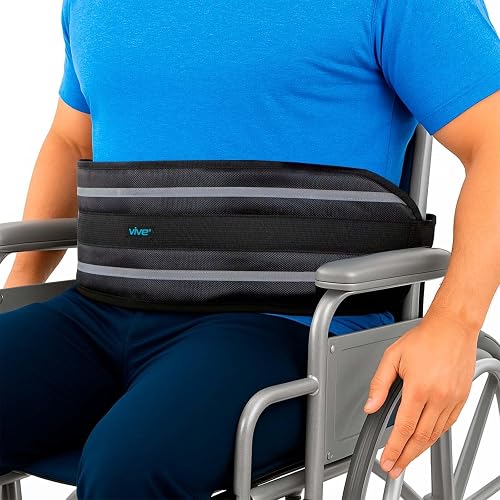
Vive Wheelchair Seatbelt: Best for wide padded comfort
- Wide padded belt
- Fits combined 37 to 75 in circumference
- Reflective strips
- Reinforced stitching
A wide, softly padded belt sized around user and chair together. Reflective strips and reinforced stitching add visibility and durability.
Pros
- Wide design spreads weight
- Padded to reduce skin discomfort
- Clear combined measurement range
Cons
- You must measure user plus chair
- Narrower range than some long straps
Vive suits elderly, pregnant or disabled users who slouch or slip in a wheelchair and need torso support.
Its wide padded belt spreads weight across the surface, which can reduce skin friction compared with a narrow strap.
Fit is unusually clear here.
Vive says the belt wraps around user and backrest for combined circumferences from 37 to 75 inches.
Measure around the seated user and chair back together at belt height before you order.
Reflective strips add visibility in low light, and reinforced stitching helps the belt stay tight under direct force.
Vive also gives a 60-day guarantee, which matters if the first fit is not right.
The trade-off is range.
At 75 inches combined, it stops short of the PSNOOK long range.
If your combined measurement is near the top, give yourself margin rather than aiming for the maximum.
Choose Vive for comfort on a standard chair where padding and clear sizing matter.
Our best wheelchair seat belt guide helps if you want more detail on lap belts before you decide.
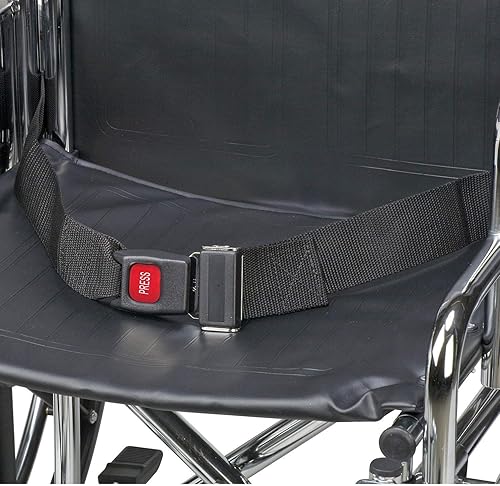
HEALTHLINE Wheelchair Strap Seat Belt: Best for auto-style buckle use
- 48 in adjustable strap
- Auto-style push-button buckle
- Metal buckle
- For most chairs with 1 in tubing
A manually tightened 48 inch positioning belt with an auto-style metal buckle. It suits many chairs but needs anchor points or added hardware.
Pros
- Familiar push-button release
- Firm clicking buckle
- Easy to wipe clean
Cons
- Not retractable
- Not crash-rated or for vehicles
- May need added hardware
HEALTHLINE suits users who already know car-style buckles and want the same push-button action.
Its auto-style buckle clicks firmly and releases with a push button, which can be easier than a side-release for some hands.
The strap is 48 inches and tightened manually, so it is not retractable.
That keeps the design simple, but you must set tension each time and confirm it before use.
High-strength woven fabric with reinforced stitching supports that routine.
Mounting is the key check.
HEALTHLINE says it fits most wheelchairs with 1 inch tubing or existing mount holes, with grommets for screw-on attachment.
Chairs without anchor points may need modification or added hardware.
This belt is described as a positioning belt, not a restraint system and not crash-rated.
Some nursing facilities restrict seat belts as restraints, so check facility policy first if care is shared.
Pick HEALTHLINE if you want a familiar buckle and a simple manual strap.
Skip it for vehicles or for chairs where you cannot find safe anchor points.
Fanwer Wheelchair Seat Belt: Best for vest-style upper body support
- Vest-style design
- Four adjustable straps
- Metal buckles
- Washable breathable fabric
A vest-style belt that wraps the upper body with four adjustable straps. Wide strap contact aims to spread pressure during longer use.
Pros
- Wraps upper body
- Four-way adjustment
- Extra strap stored by slide buckle
Cons
- Not for babies or small sizes
- More complex to put on than a waist belt
Fanwer suits people who need more than a lap belt and want upper body wrap.
Its vest-style design wraps the entire upper body, and wide straps spread contact pressure during longer sitting.
Four straps adjust like a car seat belt, with a maximum horizontal length of 190 cm and vertical length of 270 cm.
That covers many body types, though Fanwer says it is not for babies or people of small size.
Metal buckles fix the belt firmly, and a slide metal buckle stores extra strap length.
That helps prevent loose ends from dangling, which is a small detail that matters in daily wheelchair use.
The fabric is described as strong, breathable and washable.
Washable fabric is useful after spills, but check care needs for your home setup before relying on frequent washing.
The trade-off is complexity.
A vest takes longer to put on and take off than a waist belt.
Choose Fanwer for added upper body positioning, not for quick lap-only support.
PSNOOK Adjustable Wheelchair Safety Strap Seat Belt: Best for wide adjustment range
- 2 in wide belt
- 13 to 86 in adjustable length
- Side-release buckle
- Wraps around backrest bars
A 2 inch wide lap belt with a 13 to 86 inch range and side-release buckle. It wraps around backrest bars for quick install.
Pros
- Very wide adjustment range
- Two-finger side press release
- Reinforced cross-box stitching
Cons
- Long extra strap may need managing
- One-piece design limits style options
PSNOOK suits seniors and people with limited mobility who need a lap belt that fits many chair sizes.
Its 13 to 86 inch length is the widest range in this group, and the belt is 2 inches wide.
The one-piece strap threads and wraps around wheelchair backrest bars, so install is quick and tool-free.
A reinforced side-release buckle locks with insertion and releases with a two-finger side press.
PSNOOK says premium polyester and high-strength POM buckles, plus five-twill weaving and cross-box stitching, support tensile strength and durability.
Those details matter when a belt is used every day.
The belt also adapts to transport chairs and mobility scooters, and can serve as a safety restraint, mobility aid or positioning strap.
That range is useful, but it also means you must agree with your care team on the intended role.
The trade-off is excess length at the top end.
With 86 inches available, manage loose strap so it does not snag.
For smaller users, the 13 inch low end is forgiving.
DMI Wheelchair Seat Belt and Safety Harness: Best for screw-on backrest mounting
- 45 in long, adjusts to 41 in
- 1.75 in wide
- Vehicle-style buckle
- Grommets for backrest screws
A 45 inch belt that adjusts to 41 inches and mounts with backrest screws through grommets. The buckle locks and releases like a vehicle belt.
Pros
- Simple screw-on install
- Familiar buckle action
- Strong durable strap
Cons
- Requires removing backrest screws
- Narrower fit range than PSNOOK
DMI suits caregivers who want a belt that screws directly to the backrest.
Its 45 inch length adjusts to 41 inches, and the strap is 1.75 inches wide.
Install means removing the bottom screws from the left and right side of the wheelchair backrest, inserting them through the belt grommets, then reinserting and tightening the screws.
That is more secure than wrapping, but it takes more time and needs the right screw holes.
The buckle attaches and detaches like a vehicle seat belt.
DMI describes it for preventing falling and slipping for elderly users, people with epilepsy or those with loss of muscle function.
This is a straightforward harness for a standard chair with matching backrest screws.
If your chair has no such holes, do not force this mount.
A wrap-around belt such as the PSNOOK may fit better.
The trade-off is a narrower adjustment range than the longest belts here.
Measure first, and confirm the 41 inch adjusted length works for your user.
Secure Safety Solutions Wheelchair Solid Seat Insert: Best for sling seat posture support
- 18 x 16 x 1.75 in solid insert
- Non-slip vinyl cover
- Attachment strap
- Latex-free, wipe clean
A solid seat insert that creates a flatter surface under a cushion on sling seats. The attachment strap helps keep it from shifting.
Pros
- Reduces sling seat hammocking
- Stabilizes gel, foam and air cushions
- Easy to wipe clean
Cons
- Not a belt by itself
- Fits most standard seats, not all
Secure Safety Solutions suits users whose main problem is a sagging sling seat, not a missing belt.
This solid insert measures 18 by 16 by 1.75 inches and creates a flatter surface under a cushion.
The convex design is meant to reduce hammocking, sagging, pelvic tilt and internal leg rotation.
For people who sink into a sling seat, that flatter base can improve posture support during long sits.
It stabilizes gel, foam and air cushions and helps maintain their shape.
A non-slip vinyl cover and attachment strap help keep the insert from shifting during daily use.
Materials are latex-free and flame-retardant, and the insert wipes clean with a damp cloth.
Secure says it meets California #117 flame retardant standards and includes a one-year warranty.
The trade-off is clear: this is seat support, not a wheelchair safety strap.
Pair it with a proper belt if you also need positioning.
Our best wheelchair anti tippers guide covers a related fall-prevention add-on.
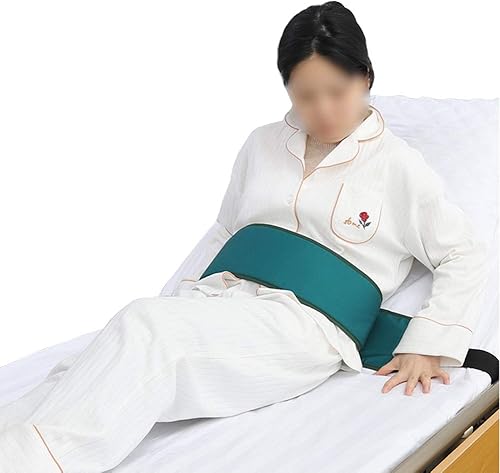
AMPHIARAUS 200Inch Bed Restraint Strap Anti-Fall Waist: Best for extra-long tethering
- 200 in total length
- 71 in adjustable strap x2
- 58 in waist cushion
- Soft breathable material
A very long 200 inch strap system with a 58 inch waist cushion for bed or wheelchair use. Length choices let caregivers choose wearing methods.
Pros
- Very long tethering length
- Large waist cushion
- Adjustable wearing options
Cons
- Excess length needs careful management
- Targeted to specific care needs
AMPHIARAUS suits caregivers who need a long strap system for a bed or wheelchair.
Its total length is 200 inches, with two 71 inch adjustable straps and a 58 inch waist cushion.
That length lets you anchor the belt to a bed frame or wheelchair in different ways.
AMPHIARAUS says adjustable length and choosable wearing ways fit different needs, which is useful when one setup must work in two places.
The waist cushion is 58 inches long and 6 inches wide at the front, tapering to 4 inches at the back.
Soft, breathable material aims to keep the user more comfortable during use.
Target users listed include people after surgery and people with senile dementia.
Those are specific care situations, so discuss restraint use with a care professional before you rely on it.
The trade-off is length management.
A 200 inch system has a lot of strap to store safely.
Choose it for bed-to-chair anchoring, not for a simple lap belt.
HOONHERY Bed Restraint Strap for Elderly: Best for padded bed waist use
- Up to 199 in restraint belt
- 57 in abdominal belt
- Polyester cotton fabric
- Built-in sponge padding
A padded waist belt with up to 199 inches of restraint length for bed or wheelchair anchoring. Polyester cotton fabric with sponge padding aims for comfort.
Pros
- Padded abdominal section
- Long adjustable tether
- Can be cleaned as a whole
Cons
- Long length may be excess for lap use
- Careful fit checks needed
HOONHERY suits home or hospital use where a padded waist belt needs a long anchor.
Its restraint belt reaches 199 inches, and the abdominal belt is 57 inches long.
The abdominal section uses polyester cotton fabric with built-in sponge padding.
HOONHERY describes it as breathable, soft and comfortable, which matters when the belt stays on for longer periods.
Length can be adjusted to the bed size and to a comfortable position.
The belt can be fixed on the abdomen and legs to hold a user in a chosen position and limit turning or tilting.
HOONHERY says it can be cleaned as a whole.
That is helpful for families who need a simple wash routine, though you should still follow the care guidance for your setting.
The trade-off is that a long bed restraint is more than most wheelchair users need.
For lap-only positioning, a shorter belt such as the DMI or PSNOOK is simpler to store and fit.
How to compare wheelchair safety straps by fit, adjustment and release
The best wheelchair safety straps are not always the longest or the most padded.
Compare them by fit range first, then by how the buckle releases, then by how the belt mounts to your chair.
Fit range tells you who the belt can hold safely.
Vive states a combined 37 to 75 inch range.
PSNOOK states 13 to 86 inches.
DMI states 45 inches adjusting to 41 inches.
Those numbers let you rule out belts before you look at extras.
Release design decides daily ease.
A quick-release buckle helps with transfers.
An auto-style push button feels familiar to car users.
A side-release buckle can be pressed with two fingers.
A vest with four straps takes longer but wraps more of the upper body.
Mounting decides whether the belt fits your chair at all.
Some wrap around backrest bars.
Some screw through grommets into existing holes.
Some need 1 inch tubing or anchor points.
A belt that cannot mount safely will not help, no matter how strong the strap is.
Padding and width decide comfort.
A wide padded belt spreads weight and may reduce skin irritation.
A narrow belt is lighter and simpler, but it can press harder in one place.
Check width against the user's waist and hip bones.
| Product | Best for | Type | Release | Fit | Our score |
|---|---|---|---|---|---|
| NEPPT Wheelchair Seatbelt Restraints for Dementia Patients | fall prevention and sliding | Waist safety harness | Quick-release buckle | Adjustable length | 9.7 |
| Vive Wheelchair Seatbelt | wide padded comfort | 9.6 | |||
| HEALTHLINE Wheelchair Strap Seat Belt | auto-style buckle use | 9.4 | |||
| Fanwer Wheelchair Seat Belt | vest-style upper body support | 9.2 | |||
| PSNOOK Adjustable Wheelchair Safety Strap Seat Belt | wide adjustment range | 8.9 | |||
| DMI Wheelchair Seat Belt and Safety Harness | screw-on backrest mounting | 8.7 | |||
| Secure Safety Solutions Wheelchair Solid Seat Insert | sling seat posture support | 8.4 | |||
| AMPHIARAUS 200Inch Bed Restraint Strap Anti-Fall Waist | extra-long tethering | 8.2 | |||
| HOONHERY Bed Restraint Strap for Elderly | padded bed waist use | 8.0 |
How we compared these wheelchair safety straps
We compared the specs, features and stated limits for each belt.
We looked at fit range, buckle type, mounting method, padding, materials and whether the belt is described as positioning-only or for broader restraint use.
We did not test these belts.
Scores come from how well each product fits the keyword search for wheelchair safety straps, wheelchair restraints for elderly users and wheelchair safety strap buyers.
Where a maker states a clear limit, we used it as a buying rule.
Where size is not stated, we flagged it as a measure-first purchase.
That keeps the comparison honest and helps you avoid a belt that cannot fit your chair.
What size wheelchair safety strap do I need?
The right size depends on whether you are measuring a lap belt or a belt that wraps user plus chair.
For a combined wrap, measure around the seated user and the backrest at belt height.
Vive uses that combined method and gives a 37 to 75 inch range.
If your measurement is outside that range, look at the PSNOOK 13 to 86 inch range or a longer bed strap.
For a lap belt, measure waist width while seated.
Add room for the chair frame and for clothing.
A 48 inch HEALTHLINE strap or a 45 inch DMI belt may fit a standard adult, but measure first.
Lap belts vs combined wrap belts
Lap belts sit across the waist and are simpler for daily use.
Combined wrap belts go around user and backrest, which can give more positioning support for people who slouch.
When to measure twice
Measure seated, not standing.
Posture changes waist size, and a belt that fits while standing may be too tight or too loose in the chair.
Recheck after clothing changes or weight changes.
Which buckle is easiest for daily transfers?
The easiest buckle is the one a caregiver can release quickly and safely.
Quick-release and push-button buckles are both fast once you learn them.
NEPPT uses a quick-release buckle for easy release when needed.
HEALTHLINE and DMI use auto-style buckles that click and release with a push button.
PSNOOK uses a side-release buckle with a two-finger press.
Side-release vs push-button
Side-release buckles can work well when you want a low-profile release.
Push-button buckles feel familiar if the user already knows car belts.
Try the motion before you buy if hand strength is limited.
Vest straps for upper body support
Fanwer's vest-style design wraps the upper body with four straps.
That adds positioning support, but it also adds time.
Choose it when upper body wrap is the goal, not when you need a fast lap belt.
How do I install a wheelchair safety strap safely?
Safe install starts with a solid anchor point.
Wrap-around belts thread around backrest bars.
Screw-on belts need existing holes and screws that match the chair.
DMI install removes bottom backrest screws, inserts them through grommets, then tightens them back in place.
HEALTHLINE uses grommets for screw-on attachment and fits many chairs with 1 inch tubing or existing mount holes.
PSNOOK wraps around backrest bars with no tools.
NEPPT also installs without tools.
Tool-free does not mean check-free.
After install, tug the belt, check the buckle and confirm it sits flat.
What to check after install
Check that the belt does not twist.
Check that stitching is intact and grommets are seated.
Check that the user can be released quickly for transfers.
Replace any belt with a weak buckle or damaged strap.
When added hardware is needed
Some chairs have no anchor points.
HEALTHLINE warns that modification or added hardware may be needed.
If you cannot find a safe mount, choose a wrap-around design instead of forcing screws into the wrong place.
Are wheelchair restraints for seniors safe to use at home?
Wheelchair restraints for seniors can help with positioning, but they need a clear purpose and regular checks.
A belt used to prevent sliding is different from a belt used to limit all movement.
HEALTHLINE describes its belt as a positioning aid, not a restraint system.
It also warns that some nursing facilities restrict seat belts as restraints.
That warning applies at home too: agree on the goal with family or a care professional.
Use the least restrictive option that meets the need.
A padded waist belt, a solid seat insert or a vest can each solve a different problem.
Reassess as mobility, posture or cognition changes.
Skin and comfort checks
Check skin under the belt often.
Wide padded belts such as the Vive can spread weight, but no belt removes the need for checks.
Look for redness, pinching or twisting after seating.
Talk to a care professional
If a person tries to climb out, has seizures, dementia or sudden confusion, talk to a doctor or therapist.
A belt is one tool.
It is not a substitute for supervision or medical care.
Which wheelchair safety strap should you buy?
The best wheelchair safety straps for most buyers are the NEPPT for simple waist positioning and the Vive for wider padded comfort.
Both solve the core job without a long learning curve.
Pick the PSNOOK if you need the widest lap-belt range and a side-release buckle.
Pick the HEALTHLINE or DMI if you prefer an auto-style buckle and can use existing mount holes or backrest screws.
Pick the Fanwer if upper body wrap matters more than speed.
Pick the AMPHIARAUS or HOONHERY only if you need a long bed anchor.
Pick the Secure insert if sagging sling seat posture is the main problem, and pair it with a belt if you also need positioning.
Before you order, measure the user seated and confirm the anchor points on your chair.
That one check prevents most returns and helps you choose between a lap belt, a combined wrap and a long tether.
Our score weighs specs, features and buyer feedback against what you're shopping for.
Use that score as a starting point, then let fit range and mounting method make the final call.
Our top 3 picks at a glance
-
1
Best for fall prevention and sliding
NEPPT Wheelchair Seatbelt Restraints for Dementia Patients
9.7/10 our score
See it on Amazon -
2
-
3
Best for auto-style buckle use
HEALTHLINE Wheelchair Strap Seat Belt
9.4/10 our score
See it on Amazon
Frequently asked questions
Are wheelchair safety straps the same as seat belts?
Not always. Many wheelchair straps are positioning belts that help keep a seated person from sliding or slouching.
They are not the same as crash-rated vehicle belts.
Check whether a belt is described as positioning-only before you use it for transport.
How do I measure for a wheelchair safety strap?
Measure the combined circumference around the seated user and the chair back at belt height. Vive gives a clear 37 to 75 inch combined range for that method.
For lap belts, measure waist width and add room for the chair frame.
Can these belts be used in a car or van?
Most belts here are not described as crash-rated. HEALTHLINE states its belt is not for cars, vans or power equipment where crash standards apply.
Use a vehicle-approved restraint system for transport instead.
What should I check before each use?
Check buckle clicks, strap tightness, fraying, grommets and anchor points before each use. Confirm the belt sits flat without twisting.
Stop and replace a belt with damaged stitching or a weak buckle.
Do nursing facilities allow wheelchair restraints for seniors?
Policies vary by facility. HEALTHLINE warns that some nursing facilities restrict seat belts as restraints.
Ask the care team about local policy before you buy or install one for shared care.


