Types of Mobility Scooters: Which Should You Choose?
The right type of mobility scooter depends on where you ride most. Choose a folding 3-wheel model for travel and tight indoor spaces, a standard mid-size model for daily neighborhood use, and a heavy-duty 4-wheel model for rough outdoor terrain.
On this page (12 sections)
- How do types of mobility scooters differ in daily use?
- How does a standard mid-size mobility scooter fit everyday life?
- What makes a heavy-duty mobility scooter different?
- How does wheel count affect maneuverability?
- How do folding mobility scooters compare with fixed-frame models?
- What does portability really mean for a travel scooter?
- How do knee scooters fit among mobility scooter types?
- How does terrain change which scooter type you should buy?
- What do weight capacity and range mean in real use?
- What should you check if you already own a scooter?
- How do brands help you choose among scooter types?
- Which type of mobility scooter should you choose?
The main types of mobility scooters are folding travel models, standard mid-size models and heavy-duty models. Each type trades portability for stability, range and outdoor performance.
If you ride mainly indoors or travel by car, a folding model fits best. If you need daily neighborhood range, a standard model fits best.
If you ride on grass, gravel or steep paths, a heavy-duty model fits best.
This guide compares scooter configurations by maneuverability, portability and intended riding environment. We checked the specs for the models linked below.
We did not test them by hand.
How do types of mobility scooters differ in daily use?
Types of mobility scooters differ first by where the scooter will travel and how you will carry it. That choice affects wheel count, frame size, battery size and weight capacity.
A travel scooter is built to come apart or fold. A standard scooter is built to stay assembled.
A heavy-duty scooter is built to handle weight and rough ground. Those design goals pull in opposite directions.
Start with your most common route, not your longest possible route. A short indoor route needs a tight turning radius.
A long outdoor route needs range and larger wheels.
Folding travel scooters for cars, airports and cruises
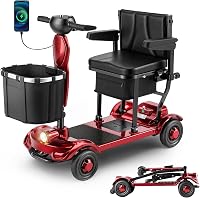
Folding travel scooters break into lighter pieces or fold flat for a trunk. They use smaller wheels and smaller batteries, which keeps weight down but limits range.
They suit airports, malls, cruise ships and short errands. They suit riders who can lift the heaviest part, often 26 to 35 lb.
The SuperHandy Passport is a 3-wheel, airline travel friendly model. It has a 48V brushless motor, forward and reverse, and a 275 lb capacity.
It weighs 26 lb broken down and 35 lb total.
It includes 2 removable 44.4V lithium-ion batteries and a charger. Each battery gives about 6.5 miles, for over 12 miles total.
You can swap a charged battery in seconds when one runs low.
It disassembles into 5 pieces that fit in a sedan trunk. Its 3-wheel design helps in tight spaces.
It has flat-free, non-marking tires and a tote bag.
There are clear trade-offs. It has no armrests, so you hold the handlebars.
A caregiver or rider must be able to lift 35 lb for transport. The drum brake is user-adjustable, and brake sensitivity can drop as shoes wear.
Rule: choose a folding travel scooter only if you can lift its heaviest part and your typical trip fits its range.
How does a standard mid-size mobility scooter fit everyday life?
A standard mid-size mobility scooter is the best all-around choice for daily indoor and neighborhood use. It keeps a seated position with armrests and a larger battery than most travel models.
Mid-size scooters usually ride on 4 wheels for a stable base. They turn less tightly than a 3-wheel travel model, but they feel more secure on paths and ramps.
They suit shopping, appointments, church, school pickup and short neighborhood rides. They are harder to lift into a car, so many owners keep them at home or use a ramp.
Our best mobility scooters for seniors guide helps you compare mid-size models by seat comfort, range and turning space. Read it if this is your first scooter purchase.
Choice of brand also matters for parts and service. Our best mobility scooter brands list explains what to look for in dealer support and battery availability.
Rule: choose a standard mid-size scooter if daily comfort and range matter more than lifting it into a car.
What makes a heavy-duty mobility scooter different?
A heavy-duty mobility scooter is built for higher weight capacity, larger wheels and rough outdoor ground. It is the types of mobility scooters category you choose for farms, parks and steep routes.
Heavy-duty models use a stronger frame and motor. They ride higher off the ground.
They cost more in weight, so they are usually not meant to be lifted by hand.
Our heavy duty mobility scooter guide explains what to expect from suspension, ground clearance and battery size. Read it before you assume a standard model can handle the same terrain.
A heavy-duty scooter still has limits. Wet grass, deep gravel and very steep slopes can stop any scooter.
Check the maker's slope and terrain guidance for your exact model.
Rule: choose heavy-duty only if your routes include rough ground or higher rider weight that a standard model cannot support.
How does wheel count affect maneuverability?
Wheel count affects turning radius and stability more than speed. A 3-wheel scooter turns tighter.
A 4-wheel scooter feels steadier outdoors.
A 3-wheel base has a smaller footprint. It pivots well in a hallway, elevator or small shop aisle.
It can feel less stable on a side slope or a curb cut.
A 4-wheel base spreads weight across two front wheels. It resists tipping on uneven pavement.
It needs more room to turn and can feel wider in a tight bathroom entry.
Test the turn in the space where you will use it most. Measure the narrowest doorway, elevator and turn in your home before you buy.
The SuperHandy Passport's 3-wheel layout is a good example. It is aimed at tight-space maneuverability for airports, malls and cruises.
That same layout would not be the first choice for a gravel farm path.
Rule: choose 3 wheels for tight indoor turns and 4 wheels for outdoor stability.
How do folding mobility scooters compare with fixed-frame models?
Folding mobility scooters win on portability, while fixed-frame models win on comfort and range. Folding frames must stay light and compact.
Fixed frames can carry larger batteries and seats.
Our folding mobility scooter guide shows what this type looks like and what folds or breaks down. Read it if you plan to carry the scooter in a car.
A fixed-frame scooter stays ready to ride. You roll it out and go.
It often has armrests, a larger deck and a higher weight limit.
A folding scooter may need assembly at each stop. You may need to lift pieces, reconnect the battery and check the brake.
That extra step matters if you travel weekly.
The SuperHandy Passport breaks into 5 pieces rather than folding to one slab. That design fits a sedan trunk, but it requires lifting separate parts.
Confirm you can manage each piece.
Rule: choose folding if you must carry the scooter, and choose fixed-frame if it will mostly stay in one place.
What does portability really mean for a travel scooter?
Portability means the weight of the heaviest part you must lift, not just the total weight. A 35 lb total can still mean a 35 lb lift if parts do not separate evenly.
Check three numbers before you buy. Check the total weight, the heaviest single piece and the folded or broken-down dimensions.
Check them against your car trunk and lift.
Check battery rules for air travel. Lithium-ion batteries have airline limits, and rules change by airline and country.
Confirm the rules for your trip before you buy for flying.
Check range with your real load. A rated range assumes ideal conditions.
Hills, wind, cold and higher rider weight reduce real range.
The SuperHandy Passport includes 2 batteries for over 12 miles total. That helps on a long airport day.
It still requires a 35 lb lift for transport, and the maker advises you to consult your physician to confirm fit.
Rule: choose a travel scooter by heaviest lift and real trip distance, not by headline weight alone.
How do knee scooters fit among mobility scooter types?
A knee scooter is a manual aid for a temporary foot or ankle injury, not a powered mobility scooter. It is useful to know because it is often suggested as an alternative to crutches.
The Vive Mobility All Terrain Knee Scooter Walker supports up to 350 lb. Its knee platform adjusts from 20 to 26 in.
Its steering handle adjusts from 38 to 46 in. It is aimed at people 5'4" to 6'6".
It has a contoured foam knee pad that cradles the lower leg. It has 12-inch pneumatic wheels for carpet, gravel, grass, dirt and pavement.
It has a dual rear friction brake system for uneven surfaces and gentle inclines.
It includes a storage bag for everyday items. The knee platform is removable and the steering handle folds for storage in a car.
It weighs 30.51 lb and measures 36 x 18 x 45.5 in.
This model suits post-surgery recovery and short-term use. It does not replace a powered scooter for long-term mobility, seated riding or long daily distances.
Rule: choose a knee scooter for temporary lower-leg recovery, not as a long-term substitute for a powered scooter.
How does terrain change which scooter type you should buy?
Terrain changes which scooter type you should buy because wheel size, ground clearance and tire type decide where you can ride. Smooth indoor floors need the least equipment.
Carpet and smooth tile suit almost any type. Flat pavement suits standard and travel models.
Grass, dirt and gravel need larger pneumatic wheels and more power.
The Vive knee walker's 12-inch pneumatic wheels show how wheel size changes ground handling. Large wheels roll over small bumps more easily than small solid wheels.
For powered scooters, check tire type before you buy. Flat-free tires reduce puncture worry but ride harder.
Pneumatic tires absorb bumps but need air pressure checks.
Check ground clearance for thresholds and curb cuts. A standard scooter may clear a threshold that a low travel scooter cannot.
Measure the highest step on your route.
Rule: match wheel size and clearance to your roughest regular surface, not to your smoothest one.
What do weight capacity and range mean in real use?
Weight capacity and range mean how much load the frame and battery can handle on your actual route. Headline numbers are a starting point, not a promise for every trip.
Weight capacity includes the rider plus any bag, groceries or medical gear. Stay under the limit with room to spare.
A scooter at its limit has less power for hills.
Range drops with hills, cold weather, headwind and frequent starts. A scooter rated for 13 miles may give much less on a hilly route.
Plan trips at about half the rated range if you are unsure.
Battery care affects range over time. Store lithium-ion batteries at about 50 to 70 percent charge during long storage.
Recharge about every 60 days during long storage and avoid fully draining the battery.
The SuperHandy Passport is rated at 275 lb and about 6.5 miles per battery. That capacity and range suit a lighter rider on flat travel routes.
A heavier rider or hilly route calls for a larger model.
Rule: choose capacity and range for your heaviest load and longest hilly trip, with margin left over.
What should you check if you already own a scooter?
A scooter accessory check matters because keys, brakes and batteries wear with normal use. Small parts decide whether you can ride on a given day.
The eLifecenter MS31 keys are original keys for MS31 and W3431 models. The maker says they fit most mobility scooters with the same design.
Each package has 2 keys.
The alloy tip is 1.04 in long and 0.25 in thick. Check your old keys against those measurements before you order.
The maker notes compatibility with Vive and Elifecenter scooters with the same design.
Brake checks also matter. The SuperHandy Passport uses a drum brake that is user-adjustable.
As shoes wear, brake sensitivity can drop. Turn the pre-load nut in small steps and re-test on level ground.
Our mobility scooter motor guide helps you judge motor and drivetrain issues. Our cane buying guide helps if you also need a walking aid for short indoor trips.
Rule: keep spare keys and check brake hold monthly, because a small part can stop a trip.
How do brands help you choose among scooter types?
Brands help you choose among scooter types because parts, batteries and dealer support differ by maker. A good model with poor support can become a poor buy.
Read our Vive mobility scooter reviews if you are comparing Vive models. Read our Golden mobility scooter reviews if you are comparing Golden models.
Each review set focuses on fit for specific uses.
Ask three questions before you buy. Can you get a replacement battery in your area.
Can you get a motor, key or brake part. Does a local dealer service the model.
A travel scooter with a common battery can stay useful for years. A discontinued model with a special battery can become hard to keep running.
That matters more than a small price gap.
Rule: choose a type first, then choose a brand with parts and service you can actually get.
Which type of mobility scooter should you choose?
Choose a folding travel scooter if you must lift it into a car or fly with it. Choose a standard mid-size scooter if you ride daily indoors and on neighborhood paths.
Choose a heavy-duty scooter if you ride on rough outdoor ground or need higher capacity.
Choose a knee scooter only for short-term recovery after a foot, ankle or lower-leg injury. Choose a 3-wheel model for tight indoor turns.
Choose a 4-wheel model for outdoor stability.
Revisit your choice if your routes change. A travel scooter that worked for cruises may not suit a new farm path.
A heavy-duty model that felt secure outdoors may be hard to store in a small apartment.
Use this guide as a decision rule, then compare specific models by capacity, range, turning radius and heaviest lift. Those five specs will tell you more than the scooter name alone.
Frequently asked questions
What are the main types of mobility scooters?
The main types are folding travel scooters, standard mid-size scooters and heavy-duty scooters. Folding models prioritize portability and fit in car trunks.
Standard models balance range and comfort for daily use.
Heavy-duty models add larger wheels, higher capacity and better outdoor stability.
What is the difference between a 3-wheel and 4-wheel mobility scooter?
A 3-wheel scooter usually turns in a tighter space and feels more agile indoors. A 4-wheel scooter gives a wider base and more confidence on uneven ground.
Choose 3 wheels for tight hallways and 4 wheels for outdoor paths, ramps and uneven pavement.
Which mobility scooter type is best for travel?
A lightweight folding travel scooter is best for travel because it breaks down or folds for a car trunk, airport or cruise. Look for removable batteries, flat-free tires and a checked weight you or a caregiver can lift.
Confirm airline battery rules before you fly.
Are knee scooters a type of mobility scooter?
A knee scooter is not a powered mobility scooter, but it serves a similar temporary role after a foot or ankle injury. It supports your knee on a padded platform while your injured leg stays raised.
It suits short-term recovery rather than long-term daily mobility needs.
What should I check before buying any mobility scooter type?
Check weight capacity, assembled weight, range, turning radius, wheel type and battery type against your actual routes. Measure doorways, lifts and vehicle space before you buy.
Confirm the rider can lift the heaviest part for transport, and talk with a clinician if fit or seating is unsure.