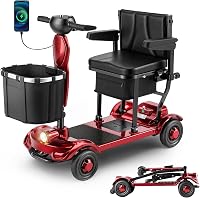
How to Choose a Folding All-Terrain Mobility Scooter
Choose a foldable all-terrain mobility scooter by balancing transport weight and folded size with the ground and slopes you need to cross. Check how it folds, what parts you must lift, and whether its tires and stability features suit your usual routes.
On this page (8 sections)
- What makes an all-terrain mobility scooter foldable?
- How do you balance folded size and rough-terrain capability?
- Which folding mobility scooter features matter outdoors?
- How should you check the lifting weight and folded dimensions?
- What surfaces should you compare before choosing?
- How do you choose between a folding scooter and a lighter model?
- Which folding all-terrain scooter should you shortlist?
- How we researched foldable all-terrain mobility scooters
Choose a foldable all-terrain mobility scooter by balancing transport weight and folded size with the surfaces and slopes you need to cross. If rider capacity is your main concern, compare 500-pound-capacity mobility scooters.
Check how it folds, what parts you must lift, and whether its tires and stability features fit your usual routes.
A scooter that fits a car may not handle rough ground well, and a capable outdoor model may be too heavy or bulky for routine transport. Measure the storage space and be honest about what you can lift before comparing features.
For a broader comparison of outdoor options, see our best all terrain mobility scooter guide.
What makes an all-terrain mobility scooter foldable?
A foldable mobility scooter is designed to reduce its size for storage or transport, but folding does not mean lightweight. If you prefer a three-wheel layout, compare folding three-wheel scooters.
Some models fold as one piece, while others separate into parts.
Look for the folded dimensions and the weight of the part you will actually lift. A total weight can hide a heavy base or other awkward piece.
Our guide to what a folding mobility scooter looks like explains common folding designs. If weight is your main concern, compare it with what makes a mobility scooter lightweight.
How do you balance folded size and rough-terrain capability?
Start with the terrain you use most often, then check the scooter’s transport measurements and handling details. A compact folded shape is useful only if the scooter can also manage your regular route.
| What to compare | Why it matters |
|---|---|
| Folded dimensions | Shows whether it fits your trunk, closet or storage space |
| Weight of each part | Helps you judge loading and unloading |
| Tire size and type | Affects contact with the ground and suitability for surfaces |
| Ground clearance | Helps you check whether the base may catch on bumps |
| Stability features | Relevant on uneven surfaces and slopes |
| Slope guidance | Lets you compare the model with hills on your route |
| Weight capacity | Must accommodate the rider and any carried items |
Do not use “all-terrain” as a substitute for checking those details. Grass, gravel and uneven pavement differ, and a route may include curbs, slopes or tight turns that matter as much as the surface.
Is a lightweight all-terrain mobility scooter easier to transport?
A lighter scooter or lighter detachable part can be easier to load, but the lifting task depends on shape and handling as well as weight. Consider where you can grip it, how high you must lift it, and whether you need to manage the battery separately.
The ONLYWIND model is described as weighing 37.5 lb without its battery and folding to 38 x 20 x 13.5 in. Its battery is listed at 4 lb and is removable, so compare the lifting steps with your own vehicle and routine.
A foldable scooter may still need two hands, a clear lifting path or help getting it into a high trunk. Try to assess the actual loading motion, not just the number on a scale.
Does a larger scooter handle rougher ground better?
Size alone does not guarantee terrain ability. Compare tires, clearance, stability features and slope guidance for the surfaces you expect to cross.
The Mbxcooter MS20 is described with a 350 W motor, a maximum slope of 15°, and a four-part disassembly design with a foldable tiller. For another outdoor option, see heavy-duty all-terrain scooters.
Its stated weight is 85.5 lb, which makes the separate-piece weights important to check before planning car transport.
Those details can help you shortlist a model, but they do not tell you how it will handle every route. Ask the maker about the ground conditions you face if the guidance is unclear.
Which folding mobility scooter features matter outdoors?
Prioritize the features that match your exact route and loading routine. More features do not automatically mean a better fit.
The Mbxcooter is a mobility scooter built for seated travel, with detachable lithium battery, adjustable seat and armrests, anti-tip wheels and front anti-collision bar. It comes apart into four pieces and has removable baskets, which may help with storage, though the scooter’s listed total weight is 85.5 lb.
For surface grip, tire details matter. See our guide to best all-terrain mobility scooter tires for tire considerations, and compare mobility scooters for hills if your route includes slopes.
If weather protection matters more than compact storage, an enclosed mobility scooter may fit your needs better.
How should you check the lifting weight and folded dimensions?
Measure the vehicle opening, cargo space and storage spot before deciding. Compare them with the folded scooter and with each part you would handle.
- Measure the narrowest trunk opening or hatch.
- Measure the cargo floor, including usable width between wheel wells.
- Check folded height and length, plus space for any detached parts.
- Identify the heaviest part you must lift.
- Consider whether the battery must be removed before loading.
- Plan where baskets, chargers and other loose parts will go.
Do not assume a scooter fits because its folded length is shorter than the trunk floor. The opening shape, rear seat angle and room needed to turn the scooter can prevent loading.
ONLYWIND publishes a folded size and a weight without the battery. Mbxcooter describes four-part disassembly, but its total weight alone does not show the weight of each piece.
Check the handling details that apply to the model and configuration you plan to buy.
What surfaces should you compare before choosing?
Write down the surfaces on your regular route, then compare them with the maker’s terrain guidance and the scooter’s features. Think beyond the main path to entrances, transitions and places where you need to turn or stop.
A route might include smooth indoor floors, pavement, grass, gravel or uneven sidewalk joints. The Vive Mobility All Terrain Knee Scooter Walker is a knee walker for people recovering from foot, ankle or lower-leg injuries, not a seated mobility scooter for general travel.
Its 12 in pneumatic wheels are described for carpet, gravel, grass, dirt and pavement, so it can help readers comparing a different mobility aid for those surfaces.
Do not treat a knee walker as a substitute for a mobility scooter. It supports a different use and requires you to rest one knee on its platform.
For any scooter, avoid assuming that an “all-terrain” label covers deep sand, mud, steep slopes or every uneven surface. Ask the manufacturer about a route feature that could affect safe use.
How do you choose between a folding scooter and a lighter model?
Choose based on the hardest transport task you face regularly, not only the scooter’s product name. A very light design may suit frequent car loading, while a heavier model may be worth considering if outdoor performance and separable parts matter more.
The ONLYWIND model lists a lower weight without its battery and a compact folded size. The Mbxcooter is heavier overall, but it separates into four parts and lists terrain-oriented features such as anti-tip wheels and slope guidance.
Compare the options with best lightweight folding mobility scooters. If brand-specific options are on your shortlist, see our Vive mobility scooter reviews.
Which folding all-terrain scooter should you shortlist?
Choose the lightest setup you can load safely if frequent car transport is your main need, then confirm its tire and terrain details match your route. If your route has uneven ground or slopes, compare terrain features and published limits before giving folded size priority.
Consider the ONLYWIND model if its published folded size and weight without the battery fit your transport plan. Consider the Mbxcooter if its four-part design and terrain features suit your needs, while verifying the weight of each piece.
Pick a knee walker only if you need that kind of support for a foot or lower-leg injury.
How we researched foldable all-terrain mobility scooters
We compared the product details and buying factors provided for this guide, including transport dimensions, handling weight, tires and terrain features. Confirm fit, weight handling and route guidance for your specific model before you buy.
Frequently asked questions
What should I check before buying a foldable all-terrain mobility scooter?
Compare the folded dimensions and the heaviest piece you must lift with your vehicle, storage space and lifting ability. Then check the maker’s details for tire type, ground clearance, weight capacity, slope guidance and any limits on rough surfaces.
Foldable describes transport, not how well a scooter handles every kind of terrain.
Are lightweight folding mobility scooters suitable for gravel?
Some may handle gravel, but weight alone does not show how a scooter performs on it. Check the tire size and type, ground clearance, stability features and maker’s guidance for the surface.
Loose, deep or uneven gravel can be harder to cross than firm packed gravel, so match the scooter to your actual route.
Is a folding mobility scooter easy to lift into a car?
It depends on the scooter’s weight, how it folds or comes apart, and how far you must lift it. Check the weight of each piece you would handle, including the battery if it detaches.
Measure the trunk opening and cargo area, then compare those measurements with the folded scooter or largest separated part.
Can a folding all-terrain mobility scooter climb hills?
Some models publish a maximum slope, but that figure alone cannot tell you how the scooter will feel on your route. Slope, surface, rider weight, battery charge and turning space all matter.
Check the maker’s guidance and avoid treating a stated maximum as a promise of safe handling in every condition.
Does all-terrain mean a scooter can go anywhere outdoors?
No. All-terrain is not a guarantee that a scooter can cross every outdoor surface.
Compare the tire design, ground clearance, stability features and slope guidance with the path you plan to use.
Deep sand, mud, steep slopes and loose stones may call for a different route or a different mobility option.