Drop Arm Commode vs Bedside Commode: Which to Choose? (November 2026)
Choose a drop arm commode when you need easier lateral transfers; choose a standard bedside commode when fixed armrests meet your needs. Compare transfer access, seat height, capacity and cleaning before you decide.
On this page (10 sections)
- Drop arm commode vs bedside commode: which is easier to transfer into?
- Which commode gives you the right seat height?
- How much weight capacity do you need?
- Which commode is best for bedside use?
- Which model works best over a regular toilet?
- Is a padded drop arm commode worth choosing?
- What is the best bariatric drop arm commode?
- How should you clean and manage the bucket?
- What should you check before buying?
- Drop arm commode vs bedside commode: which should you choose?
Choose a drop arm commode when you need easier lateral transfers; choose a standard bedside commode when fixed armrests meet your needs. The right choice depends on how the user moves, how much support they need to stand, and how much room you have beside the bed or toilet.
A drop arm commode has an armrest that lowers for side access. That opening can make a wheelchair transfer simpler because the chair and commode can sit closer together.
A standard bedside commode keeps its armrests fixed. Those arms can provide leverage for sitting and standing, but they may block a sideways move from a wheelchair.
Transfer direction should guide your decision more than the product name. Someone who approaches from the front may get enough support from fixed arms.
Someone who moves sideways needs a clear path with no arm in the way. A lowered arm helps with that path, but the seat height still needs to match the wheelchair.
Seat height affects comfort and control during the move. A seat that is too high can make standing harder, while a seat that is too low can put more strain on the user and caregiver.
User weight also matters, so the stated capacity should sit above the user's weight. Check the dimensions too, because a wider frame can be harder to place in a small bedroom or bathroom.
Cleaning plans should not be an afterthought. Think about how the bucket or pail will be removed, emptied, rinsed and returned before you choose a model.
This comparison looks at 3 commode chairs and 1 liner option. We compared their stated features, dimensions and capacities against the needs of adults, seniors, wheelchair users and caregivers.
Each option suits a different routine, so focus on fit rather than assuming one style is best for everyone. The details below explain which setup suits front transfers, side transfers, bedside use and over-toilet use.
 Best for padded transfer support
Medline Drop Arm Commode Chair for Adults
 Best for extra-wide, higher-capacity access
DMI Drop Arm Portable Toilet Commode
Drop arm commode vs bedside commode: which is easier to transfer into?
A drop arm commode is usually the better choice for a lateral transfer from a wheelchair. Lowering the armrest opens the side of the seat, so the user or caregiver has fewer obstacles between the wheelchair and commode.
The Medline Drop Arm Commode Chair has padded drop-down armrests. Its height adjusts from 18–22 inches, which gives you room to match the seat to the wheelchair and the user's leg position.
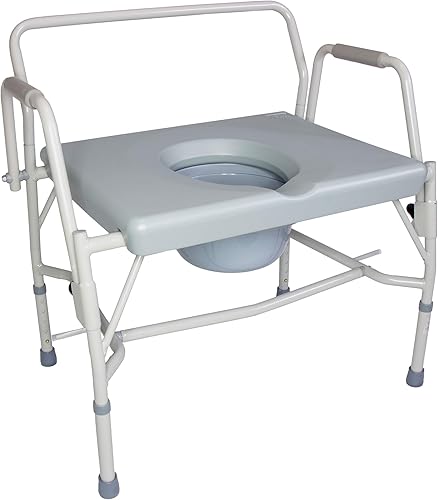
The DMI Drop Arm Portable Toilet Commode also uses a release button to lower the armrests from either side. Its seat height adjusts from 20–24 inches, and its extra-wide seat measures 23.25 inches wide.
A standard bedside commode can still work well when the user approaches from the front. Fixed armrests provide a place to hold while sitting or standing, but they don't create the same side opening.
When fixed arms are enough
Choose fixed arms when the user can approach from the front and needs arm support for standing. A standard commode may be simpler when transfers don't require a side opening.
The Drive Medical Folding Bedside Commode has supportive fixed armrests, adjustable height and a folding steel-leg design. Its 3-in-1 format allows bedside use, over-toilet use and use as a safety frame.
If the user transfers from a wheelchair, measure the chair height and the available side space first. A drop arm only helps when the commode and wheelchair can be positioned close enough for a controlled transfer.
For more detail on the mechanism and safe use, read what is a drop arm commode.
Which commode gives you the right seat height?
The best height is the one that supports a stable sitting and standing position with both feet supported. Adjustable legs or push-button settings make it easier to match the commode to the user and the room.
The Medline model adjusts from 18–22 inches. The DMI model adjusts from 20–24 inches, so it may suit someone who needs a higher seat or a taller transfer surface.
The Drive Medical commode also has adjustable height settings, but the supplied product information does not state the range. Measure the user’s current toilet or wheelchair seat before choosing.
Avoid choosing by capacity alone. A commode that supports the user's weight but sits too high or too low can still make transfers less controlled.
How much weight capacity do you need?
Choose a commode with a stated capacity above the user's body weight and follow the manufacturer's use instructions. The DMI model has the highest stated capacity in this comparison at 500 lb.
The Medline commode supports up to 350 lb. It has a steel frame, a padded seat and a removable pail, so it suits users who want transfer access and padded seating within that capacity.
The DMI commode supports up to 500 lb and has an extra-wide seat. Its total dimensions are 29.5 inches wide by 20.5 inches deep by 29.25 inches high, so measure the room before placing it beside a bed.
The Drive Medical commode supports up to 350 lb. Its fixed armrests and folding legs make it a practical standard bedside option, but the lower capacity and fixed-arm design may not suit every user.
If width, seat comfort or capacity is your main concern, compare our best drop arm bedside commode guide.
Which commode is best for bedside use?
All 3 commode chairs can support bedside toileting, but the best fit depends on transfer access and room space. Keep the commode close enough for a safe transfer without blocking the walking path or bed access.
The Medline model has a padded seat, padded drop-down armrests, adjustable height and a removable pail. Its clip-on seat can be removed for cleaning, and the pail has a splash guard.
The DMI model has an extra-wide seat, adjustable legs, non-slip feet and a removable 5-liter bucket with a snap-on lid and carry handle. Its frame is wider than the Medline and Drive models, so check the space beside the bed.
The Drive Medical model uses a fixed-arm design and a folding steel frame. Its 3-in-1 format can be useful when you want one commode to serve as a bedside chair, raised toilet seat and bathroom safety frame.
A bedside setup also needs a clear route to the commode. Keep rugs, cords and other obstacles out of the transfer path, and follow any instructions supplied with the chair.
Which model works best over a regular toilet?
Choose a model with over-toilet use when you want one frame to support both bedside and bathroom toileting. The Medline, DMI and Drive Medical models are described for flexible use over a regular toilet.
The Medline commode can be used as a raised toilet seat after removing its bucket. The DMI model has adjustable legs that allow it to fit over most standard toilets.
The Drive Medical commode provides 3-in-1 use, including use as a raised toilet seat over an existing toilet. Its adjustable height helps you set the frame to the bathroom fixture.
Measure the toilet area before choosing. Confirm that the frame can sit flat, that the arms clear nearby walls and that the user has enough space to turn or transfer.
For other bathroom access needs, our guide to grab bars covers another way to add support near the toilet and shower.
Is a padded drop arm commode worth choosing?
A padded drop arm commode is worth considering when seat comfort and side-transfer access matter together. Padding can change the sitting experience, while the drop-down arms address the transfer path.
The Medline model has a thick foam-padded seat and padded drop-down armrests. It is intended for adult and elderly users, wheelchair users and people recovering from surgery for short-term use.
The DMI model has comfortable armrests and an extra-wide seat, but its details do not describe a padded seat. Choose it for width and capacity rather than assuming the same seat feel as the Medline.
The Drive Medical model has a wide seat and supportive armrests, but its arms are fixed. It may suit a front transfer better than a lateral transfer.
See our best padded drop arm commode guide if a padded seat is one of your main requirements.
What is the best bariatric drop arm commode?
The DMI Drop Arm Portable Toilet Commode is the strongest capacity choice here because it supports up to 500 lb and has an extra-wide seat. Its adjustable legs and drop-arm access add flexibility for bedside and over-toilet use.
That combination can suit users who need more room to sit and a higher stated capacity. The drop arm also opens the side for a lateral transfer, which can reduce obstacles during the move.
The Medline model supports up to 350 lb and has a padded seat. It may be the better match when comfort and padded armrests matter more than the highest capacity.
Seat feel matters during daily use, especially for someone who sits for longer periods. A padded seat can feel more supportive, while a wider seat can help with positioning and space.
Adjustable legs give the DMI model another practical advantage. They allow the frame to be set at a height that suits the user and the toilet or bedside position.
Capacity is only one part of fit. Check the seat width, room width, transfer height and floor position before choosing any bariatric commode.
A wider commode needs clear floor space on both sides for safe placement. The caregiver also needs room to stand close enough to help without crowding the transfer path.
Set up the chair on a flat surface and confirm the legs sit securely before each use. Follow the manufacturer's instructions for weight limits, bucket care and any height settings.
Our guide to best bariatric drop arm commodes can help you compare higher-capacity options.
How should you clean and manage the bucket?
Use the chair's removable bucket or pail as directed, and clean the surfaces with the method recommended for that model. Removing the waste container before cleaning helps keep the seat and frame separate from the disposal task.
The Medline commode has a removable pail, splash guard and clip-on seat that detaches for cleaning. The DMI commode has a removable 5-liter bucket with a snap-on lid and carry handle, and its care directions include rinsing with mild soap and water.
The Drive Medical commode includes a 7.5-quart bucket with a splash shield, carry handle and protective cover. Its snap-on seat and lid install without tools.
Liners can reduce direct contact with the bucket, but they must fit securely. The Elzrghs liners are 21 x 16 inches, use medical grade LDPE plastic and have drawstrings.
The pack contains 100 liners, and absorbent pads are not included.
For more options, see best disposable commode liners.
What should you check before buying?
Measure the user, wheelchair, bathroom and transfer route before choosing a commode. A good match needs more than the right arm style.
Check these points:
- Measure the wheelchair seat and compare it with the commode seat height.
- Confirm the commode's width fits beside the bed or over the toilet.
- Choose a capacity above the user's weight.
- Decide whether the user transfers from the side or front.
- Check whether a padded seat is needed.
- Plan how the bucket will be removed, emptied and cleaned.
- Confirm that the frame can sit flat on the floor.
- Leave enough room for the caregiver to assist.
A shower chair vs shower commode comparison can help if you need toileting equipment for a wet bathroom area rather than a bedside setup.
If tub access is also difficult, compare a best tub transfer bench option before buying separate equipment.
Drop arm commode vs bedside commode: which should you choose?
Pick the Medline Drop Arm Commode Chair if you want padded seating, drop-down arms and a 350 lb capacity. Its 18–22 inch height range and over-toilet use make it the strongest comfort-focused choice in this comparison.
Pick the DMI Drop Arm Portable Toilet Commode if you need the highest capacity and an extra-wide seat. Its 500 lb capacity, 20–24 inch height range and adjustable legs suit users who need more width and a higher frame.
Pick the Drive Medical Folding Bedside Commode if fixed arms and compact storage are more important than lateral access. Its folding legs, 3-in-1 design and 7.5-quart bucket suit front transfers and flexible bathroom use.
The simple decision rule is this: choose a drop arm commode for side transfers, choose a standard bedside commode for front transfers and fixed-arm support, and match capacity and height before considering extras.
Frequently asked questions
What is the difference between a drop arm commode and a bedside commode?
A drop arm commode has an armrest that lowers or moves out of the way for easier lateral transfers. A standard bedside commode usually has fixed armrests that help with sitting and standing but can block a side transfer.
Choose based on how you move between a wheelchair and the seat.
Is a drop arm commode better for wheelchair users?
A drop arm commode is often the better fit for a wheelchair user who transfers sideways because the lowered arm creates a more open path. The Medline and DMI models both have drop-arm designs.
Check seat height, chair position and caregiver needs before use.
Can a bedside commode go over a regular toilet?
Some bedside commodes are designed for over-toilet use, but check the exact model. The Medline, DMI and Drive Medical commodes described here support this type of flexible use.
Follow the product instructions and make sure the frame sits securely before transferring.
How do you choose commode height?
Choose a height that lets the user sit down and stand up with controlled movement, while keeping both feet supported. Adjustable models offer more flexibility.
The Medline adjusts from 18–22 inches, while the DMI adjusts from 20–24 inches.
Are commode liners necessary?
Commode liners are optional, but they can simplify disposal when the bucket accepts the liner size. The Elzrghs liners measure 21 x 16 inches and use drawstrings.
They include no absorbent pad, so plan for the waste-management method you prefer.