What Is a Tub Transfer Bench?
A tub transfer bench is a bath seat that lets you sit outside the tub, slide across the tub edge, and bathe without stepping over the wall. It can support safer transfers for people with balance or mobility concerns.
On this page (8 sections)
- How does a tub transfer bench work?
- What are the main parts of a tub transfer bench?
- Who may benefit from a tub transfer bench?
- How do you choose the right tub transfer bench?
- What features help with comfort and control?
- How do you set up a tub transfer bench?
- What are the trade-offs between these three benches?
- What should you remember about a tub transfer bench?
A tub transfer bench is a bath seat that spans the bathtub wall so you can sit, slide across, and bathe without stepping over the tub edge. One side stays outside the tub, and the other side sits inside the bathing area.
This design may help people with limited balance, reduced leg strength, or difficulty standing for long periods. It can also give a caregiver a more controlled way to assist with a seated transfer.
How does a tub transfer bench work?
A tub transfer bench works by creating a seated path across the side of the tub. You sit on the outside section, move across the bench, and then position yourself over the inside section.
Many models have adjustable legs, non-slip feet, a backrest, or a seat that slides. The exact transfer method depends on the bench design and the user's ability to move safely.
The bench must stand level and stable before use. Keep the floor dry where possible, lock or secure any moving parts, and follow the product instructions for transfers.
A transfer bench does not remove every bathroom risk. You still need enough room to approach the seat, a stable place to hold if advised, and help from a caregiver when needed.
For a broader look at bathroom supports, read our guide to grab bars. Grab bars can provide a separate handhold, but they must be installed in a suitable location and used as directed.
What are the main parts of a tub transfer bench?
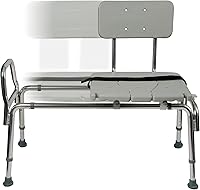
The main parts are a seat, legs on both sides of the tub, and a frame that supports the user across the tub wall. Many benches also include a backrest, arm support, adjustable feet, drainage openings, or a safety belt.
A fixed seat stays in one position. A sliding seat moves along the frame, which may reduce the need to lift or twist during the transfer.
A backrest can give support after you reach the bathing position. It does not replace a stable transfer technique or make an incorrectly fitted bench safe.
Adjustable legs help set the seat at a usable height. The legs must be adjusted evenly so the bench does not rock or slope.
Who may benefit from a tub transfer bench?
A tub transfer bench may help people who cannot safely step over a bathtub wall. It may also suit someone who becomes unsteady while standing or who needs seated assistance during bathing.
The bench can be useful for older adults, people with disabilities, and people recovering from surgery or injury. Suitability depends on strength, balance, transfer ability, and the bathroom layout.
A caregiver may need to assist with sitting, sliding, and positioning. If the user cannot control the transfer or remain seated safely, ask a qualified professional to help select the equipment and transfer method.
Which tub transfer bench suits a wide range of needs?
The DMI Tub Transfer Bench and Shower Chair has a 39 in W frame, a 19 to 23.5 in adjustable seat height, a plastic seat, and a 400 lb weight capacity. Its sliding design, backrest, safety belt, handle, suction cup rubber feet, and removable cutout support different bathing needs.
Its right- or left-side setup can help when the tub layout determines which direction the user approaches. Measure the available floor and tub space because the frame is 39 in wide.
How do you choose the right tub transfer bench?
Choose a tub transfer bench by measuring the bathroom first, then matching the seat height, weight capacity, and transfer direction to the user. The bench also needs enough clearance for the user and caregiver to move safely.
Check these points before choosing:
- Measure the tub wall, floor space, and approach area.
- Compare the seat height range with the user's leg position.
- Confirm the weight capacity exceeds the user's weight.
- Check whether the bench can be used from the needed side.
- Look for stable feet and a frame that sits level.
- Decide whether a backrest, belt, arm support, or sliding seat is needed.
- Check whether the bench requires extra clearance inside the tub.
A bench that fits the tub may still block a doorway, vanity, toilet, or caregiver pathway. Measure the full transfer route, not only the tub opening.
Read Best Tub Transfer Benches for Seniors if you want to compare models for older adults. For a direct design comparison, see tub transfer bench vs shower bench.
When is a height-adjustable bench helpful?
A height-adjustable bench helps when the seat must align with the tub edge and the user's legs. Small height changes can affect how easily the user sits down, moves across, and places their feet.
The Drive Medical Tub Transfer Bench for Bathtub has height-adjustable legs with 0.5 in incremental adjustments. It also has a supportive backrest, drainage openings, suction cup feet, an aluminum frame, and a 350 lb capacity.
Adjust both sides evenly and confirm that all feet remain firmly on the floor. The seat should not rock when you apply gentle pressure before transferring.
What features help with comfort and control?
Features that may help include a backrest, padded surfaces, armrests, a swivel seat, and a sliding or pivoting motion. The best combination depends on how the user approaches the tub and how much movement they can control.
A padded seat may feel more comfortable than hard plastic during a longer shower. Armrests can offer a place to push or steady the body, but they should not be treated as a substitute for careful transfer support.
A swivel seat can reduce twisting by turning the user toward or away from the tub. It can also change how much space the chair needs in the bathroom.
Which option has a padded swivel seat?
The Platinum Health Carousel Sliding Shower Chair Tub Transfer has a padded swivel seat, reclining backrest, padded pivoting arms, and a medical-grade aluminum and polyurethane foam construction. It is 34 in W by 21 in D by 34.5 in H and has a 330 lb capacity.
Its swivel-seat layout may suit users who need less twisting during entry or exit. Check the chair's dimensions and the tub ledge height carefully before choosing it.
Platinum Health also notes that an optional leg extension kit is available for tubs with high ledges. Confirm the required setup for your tub before ordering.
For backrest-focused options, see Best Tub Transfer Benches with Backs.
How do you set up a tub transfer bench?
Set up a tub transfer bench by placing one end outside the tub and the other end inside, adjusting the legs evenly, and checking that the frame is stable. Follow the product instructions for locking seats, belts, handles, and feet.
Keep the seat level across the tub wall. The inside legs should stand securely on the tub floor, while the outside legs should rest fully on the bathroom floor.
Remove loose bath mats from the transfer path unless they are designed to stay secure on wet floors. Keep soap, towels, and clothing within reach so the user does not need to lean or stand unexpectedly.
Before the first transfer, test the bench with gentle pressure. Do not use it if it rocks, slips, catches on the tub, or leaves too little room for the user.
Our guide to tub transfer bench use covers the transfer sequence and setup checks in more detail. If bathing is not practical on a given day, how to set up a bedside commode explains a different type of personal-care setup.
What are the trade-offs between these three benches?
The DMI model offers the highest stated weight capacity and a wide sliding frame, while the Drive Medical model focuses on half-inch height adjustments and a lighter aluminum design. The Platinum Health model adds padding, a swivel seat, reclining back support, and pivoting arms.
Choose the DMI if you need a 400 lb capacity, a removable cutout, and a sliding design with a belt and handle. Choose the Drive Medical model if fine seat-height adjustment and drainage openings matter most.
Choose the Platinum Health model if padded contact points, a swivel transfer, and pivoting arms fit the user's needs. Its 330 lb capacity and larger chair design still require careful measurement.
All three choices need a level setup and enough bathroom clearance. Compare them with the user's transfer ability, tub dimensions, and caregiver access in mind.
What should you remember about a tub transfer bench?
A tub transfer bench lets you enter a bathtub while seated instead of stepping over the tub wall. Measure the space, match the height and capacity, and check every foot and lock before use.
Choose DMI for its 400 lb capacity and broad sliding frame, Drive Medical for half-inch height adjustments, or Platinum Health for padded swivel support. The right answer to "what is tub transfer bench" is simple: it is a transfer aid, not a guarantee of safe bathing without proper fit and setup.
For added bathroom support, compare best bathroom grab bars for seniors. Use a qualified professional's advice if the user cannot transfer or sit securely.
Frequently asked questions
What is a tub transfer bench?
A tub transfer bench is a seat that spans the bathtub wall, with legs on the floor outside and inside the tub. You sit on the outer section, move across the tub edge while seated, and then position yourself inside the bathing area.
This reduces the need to step over the tub wall.
Who should use a tub transfer bench?
A tub transfer bench may suit someone who has difficulty standing, balancing, or lifting a leg over a bathtub wall. It can also help during recovery when a seated transfer is easier than stepping into the tub.
Ask a health professional or caregiver for guidance if your transfer ability is uncertain.
Does a tub transfer bench fit every bathtub?
No. Tub widths, ledge heights, bathroom space, and floor conditions vary.
Measure the tub and the open floor area before choosing a bench.
Check the bench dimensions, seat height range, and any height-extension needs against your bathroom.
Is a tub transfer bench the same as a shower bench?
No. A shower bench usually sits fully inside a level-entry shower, while a tub transfer bench spans the bathtub wall for a seated slide-over transfer.
Some products can work as shower chairs too, but the bathroom layout and transfer path still determine the right choice.