How to Use a Tub Transfer Bench
Tub transfer bench use starts with stable positioning, correct seat height, and a slow sit-and-slide transfer. Adjust the legs so your feet and the bench stay steady, then enter and exit while seated.
On this page (9 sections)
- How do you set up a tub transfer bench?
- How do you adjust the bench height?
- How do you enter a tub using a transfer bench?
- How do you exit the tub with a transfer bench?
- What features help with tub transfer bench use?
- Should you use a backrest or a swivel seat?
- How do you use a tub transfer bench safely?
- How do you clean and maintain a transfer bench?
- Which tub transfer bench suits your transfer routine?
Tub transfer bench use starts with placing the bench across the tub, adjusting the seat height, and entering while seated. The user sits on the outside section, turns or slides across the tub wall, and then moves into the bathing position.
A transfer bench can reduce the need to step over a tub wall, but it doesn't remove every fall risk. Check the bench, floor, tub edge, and user's ability to sit before each transfer.
How do you set up a tub transfer bench?
Set up the bench so one end is outside the tub and the other end is inside, with every leg level and stable on the floor. Keep the seat close enough to the outside edge for the user to sit without leaning too far.
Clear towels, bath mats, baskets, and other items from the transfer path. The floor should be dry outside the tub, and the bench should not rock when you apply gentle pressure to the seat.
Measure the tub wall, bathroom floor, and nearby fixtures before bringing the bench into place. A wide bench may need more clear floor space than a standard bath seat.
For broader bathroom planning, see this guide to grab bars. A grab bar can support a different part of the transfer, but it must be positioned and installed for the user's reach and movement.
How do you adjust the bench height?
Adjust the legs so the seat is level and the user's feet can rest firmly on the floor before the transfer begins. Change the legs evenly when the design allows, then check each adjustment point and foot.
The seat should not slope toward the tub or away from it. A level seat makes the sit-and-slide movement easier to control and helps prevent the user from shifting unexpectedly.
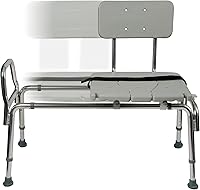
The DMI bench adjusts from 19 in to 23.5 in at the seat and has suction cup rubber anti-slip feet. Its seat is 19 in wide and 14.5 in deep, with an aluminum body and plastic seat.
The Drive Medical bench uses 0.5 in height adjustments with dual-column leg extensions. It has an aluminum frame, drainage openings, suction cup feet, a backrest, and a weight capacity of up to 350 lb.
The Platinum Health Carousel has a 19 in minimum height, a swivel seat, reclining backrest, pivoting arms, and padded surfaces. It has a 330 lb weight capacity and measures 34 in wide by 21 in deep by 34.5 in high.
How do you enter a tub using a transfer bench?
Enter the tub by sitting on the outside part of the bench first, then moving across the tub wall while seated. A caregiver should assist when the user needs help with balance, turning, or sliding.
- Stand or approach the outside section with the user's mobility aid close by.
- Turn so the back of the legs touch the bench.
- Reach for the armrest or handle if one is available.
- Lower into the seat slowly, keeping the feet supported.
- Move across the tub edge with small scoots or the bench's sliding mechanism.
- Turn the legs into the tub and settle into a stable bathing position.
Don't pull hard on a removable armrest or use a towel as a transfer strap. Keep the user's weight centered over the seat and pause if the bench shifts.
People using a wheelchair may benefit from planning the chair-to-bench position before the transfer. Learn the basic terms in [What Is a Transfer Wheelchair?
The Facts](/what-is-a-transfer-wheelchair/) if a transfer wheelchair is part of the routine.
How do you exit the tub with a transfer bench?
Exit by moving back across the tub while seated, then standing only after both feet are outside and stable. Dry the floor area first when possible, because wet feet and a wet floor can make the final movement less secure.
Slide or scoot to the outside section. Turn the body so both feet are on the floor, place hands on stable support, and stand slowly if the user can do so safely.
A caregiver should not lift the user's full weight without proper training. If the user cannot stand safely after reaching the outside section, plan for a different transfer method with a qualified professional.
What features help with tub transfer bench use?
The most useful features depend on how the user moves, how much help is available, and how much space the bathroom has. A fixed sliding seat may suit one routine, while a swivel design may give another user more control when turning.
A backrest can help the user stay supported while seated. A safety belt may add restraint during movement, but it should be used only as directed and should not replace supervision.
The DMI design can be configured for right- or left-side installation and includes a backrest, safety belt, handle, nylon strap locks, and a removable cut out. Its design spans 39 in in width, so measure the available floor space.
The Drive Medical design has a reversible layout, a supportive backrest, drainage openings, and suction-style feet. Its 350 lb capacity may suit users who need more than a basic bath seat, but the full setup still must fit the tub.
The Platinum Health Carousel uses a swivel seat with padded armrests, back, and seat. Its medical-grade aluminum and closed-cell polyurethane padding are designed for a padded surface that does not absorb water, while its 330 lb capacity and dimensions require careful measuring.
For more options, compare these best tub transfer benches for seniors by the user's transfer needs and bathroom layout.
Should you use a backrest or a swivel seat?
Choose a backrest when the user needs seated support during bathing, and consider a swivel seat when turning across the tub wall is the harder part of the transfer. The right design depends on the user's movement and the clear space around the tub.
A backrest does not keep a person upright if the seat is too high, the feet cannot reach the floor, or the user is leaning to one side. Recheck the height and position before changing the equipment.
The DMI and Drive Medical benches have backrests for seated support. The Platinum Health Carousel adds a swivel seat, reclining backrest, and pivoting arms for users who need more guided turning.
See Best Tub Transfer Benches with Backs if the user needs more upper-body support while seated. If the bathroom has limited clearance, compare a transfer bench with a smaller shower seat in tub transfer bench vs shower bench.
How do you use a tub transfer bench safely?
Use a tub transfer bench safely by checking stability before sitting, keeping the transfer slow, and avoiding unsupported standing on a wet surface. The bench is a transfer aid, not a replacement for supervision or a complete bathroom safety plan.
Before each use, check that:
- All legs touch the floor evenly.
- Adjustment pins or locks are engaged.
- Suction feet sit flat on a clean surface.
- The bench does not rock under light pressure.
- The path from the mobility aid to the bench is clear.
- The user can reach the handle or armrest without twisting.
- The tub side and floor are free from loose objects.
Keep soap, towels, and bathing supplies within reach after the user is seated. Avoid reaching across the tub if it causes the user to lean or twist.
A grab bar installation should be planned around the wall structure and the user's reach. Do not treat a towel bar, shower curtain rod, or freestanding object as a grab bar.
How do you clean and maintain a transfer bench?
Clean the bench by removing residue, rinsing approved surfaces, and drying the frame and feet. Follow the care directions for the specific materials, especially on padded seats and adjustable joints.
Check the legs, adjustment holes, locks, seat fasteners, handles, belts, and feet at regular intervals. Stop using the bench if a part is cracked, loose, bent, or no longer holds its position.
Keep drainage openings clear so water does not collect on the seat. Dry the floor around the outside legs before the next transfer.
A shower chair follows many of the same positioning and movement rules. Review how to use a shower chair correctly for seated bathing habits that also apply to a transfer bench.
Which tub transfer bench suits your transfer routine?
For tub transfer bench use, choose the DMI for a wide sliding setup with a 400 lb capacity, the Drive Medical for fine 0.5 in height adjustments, or the Platinum Health Carousel for a padded swivel design. Measure the tub and floor space before choosing any of them.
Choose the DMI when the user may benefit from a cut out, safety belt, handle, and right- or left-side setup. Choose the Drive Medical when small height changes matter for foot placement and positioning.
Choose the Platinum Health Carousel when padded surfaces, pivoting arms, and a swivel seat fit the user's transfer needs. Its 330 lb capacity and larger 34 in width still make careful measuring essential.
The safest routine is the one the user can complete with stable feet, a level seat, and enough assistance. If those conditions are not possible, ask a qualified health professional to review the transfer plan before regular use.
Frequently asked questions
How do you use a tub transfer bench?
Position the bench with one end outside the tub and one end inside, then lock or secure the legs as directed. Adjust the seat so the user can sit with stable feet, sit down from the outside, and slide across the tub edge slowly before bathing.
Should a tub transfer bench go inside or outside the tub?
A tub transfer bench spans the tub wall, with part of the seat outside and part inside the tub. This lets the user sit before moving across the tub edge, so measure the bathroom and tub area to confirm the bench fits without blocking safe entry.
How high should a tub transfer bench be?
Set the bench height so the user can sit with both feet supported and the knees in a stable position. Adjust each leg evenly, check that the seat is level, and follow the product instructions for the available height range.
Can you use a tub transfer bench without help?
Some people may transfer independently, but assistance depends on balance, strength, and the bench setup. Use a caregiver when needed, keep the movement slow, and ask a health professional to help plan transfers if the user cannot sit or slide safely.