What Is a Gait Belt Used for in Nursing?
A gait belt helps a caregiver steady and guide a patient during walking, standing, sitting, or transfers. It is not a lifting sling, and it should only be used when the patient can bear some weight.
On this page (9 sections)
- What Is a Gait Belt Used for in Nursing?
- What does a gait belt do during patient care?
- Is a gait belt the same as a transfer belt?
- When should a nurse use a gait belt?
- How do you use a gait belt safely?
- Which gait belt features matter most?
- How tight should a gait belt be?
- Who should not use a gait belt without guidance?
- What is a gait belt for nursing, in simple terms?
What Is a Gait Belt Used for in Nursing?
A gait belt is used in nursing to help steady and guide a patient during walking, standing, sitting, or transfers. It gives the caregiver a firm handhold around the waist when the patient can take part in the movement.
A gait belt is not a lifting sling. It should not be used to hoist a person who cannot bear weight, and it does not replace a patient lift when a mechanical transfer is needed.
What does a gait belt do during patient care?
A gait belt gives the caregiver better control while the patient moves under their own effort. It can help with a bed-to-wheelchair transfer, a wheelchair-to-toilet transfer, standing from a chair, or short assisted walks.
The belt also gives the caregiver a consistent place to hold instead of grabbing a patient's clothing or arm. The goal is to guide movement and reduce sudden loss of balance, not to drag or carry the patient.
Nurses, nursing assistants, therapists, and family caregivers may use gait belts when the patient's care plan allows it. Training and facility policy still matter because the right transfer method depends on the person's condition.
Is a gait belt the same as a transfer belt?
A gait belt and a transfer belt usually describe the same type of waist belt used to assist movement. “Gait belt” often emphasizes walking, while “transfer belt” may emphasize moving between a bed, chair, wheelchair, or toilet.
Some belts have handles, while others are plain webbing. Handles can give the caregiver more grip positions, but they do not turn the belt into a lifting harness.
If you're comparing options for home care, our guide to the best gait belts for seniors covers common features and fit questions.
When should a nurse use a gait belt?
A nurse should use a gait belt when the patient can follow directions, bear some weight, and take part in the transfer or walk. The nurse should first check the patient's balance, strength, alertness, footwear, and the path between surfaces.
A gait belt may help when a patient is weak after illness, recovering from a procedure, starting physical therapy, or at risk of losing balance. The patient's care plan and local procedure should guide the decision.
Do not assume a gait belt is safe just because the patient can sit up. A person may need a different transfer method if they cannot stand, become confused, have severe weakness, or cannot respond to instructions.
What is a gait belt not used for?
A gait belt is not used as a substitute for a patient lift, sling, or full-body support device. It is also not a reason to lift under the patient's arms, twist the patient's body, or pull hard against the waist.
The caregiver should not use the belt to compensate for poor positioning or an unsafe environment. Move obstacles, lock wheelchair brakes when appropriate, and set up the destination before starting.
For a different support task, see how to use a patient lift sling. A leg support task may call for a leg lifter strap instead.
How do you use a gait belt safely?
Use a gait belt safely by checking the patient and the environment first, placing the belt snugly around the waist, and guiding the movement with clear instructions. Keep your own body position stable and avoid twisting while assisting.
A basic sequence is:
- Explain the movement and confirm that the patient can help.
- Clear the route and position the destination close by.
- Place the belt around the waist over clothing.
- Fasten it securely and check that it is snug.
- Stand close, use the belt as a handhold, and give simple instructions.
- Move at the patient's pace and stop if balance or cooperation changes.
Use the belt according to training and facility policy. The best gait belt for CNAs may differ from the best choice for occasional home transfers because work settings can involve different routines and users.
Which gait belt features matter most?
The key features are fit, buckle design, belt width, material, and the number and position of handles. Choose a size that fits the patient's waist without excessive slack, and confirm that the buckle can be fastened and released reliably.
For larger fit ranges and higher capacities, compare bariatric gait belts.
A wider belt may spread contact over more of the waist. Handles can help a caregiver choose a hand position based on the direction of movement, but the belt must still be used for guidance rather than lifting.
NYOrtho Gait Belt
The NYOrtho Gait Belt adjusts from 28 to 55 in and has a 4 in height, nylon webbing, a quick-release buckle, 6 heavy handles, and a stated 275 lb capacity.
This option may suit a home or care setting where waist adjustment from 28 to 55 in is useful. Its 4 in height gives more contact area than a narrower belt, while the six handles include vertical and horizontal positions.
Check the patient's waist and the caregiver's preferred hand position before choosing it. It may be less suitable if the stated 275 lb capacity or 28 to 55 in adjustment range does not fit the care situation.
Vive Gait Belt
The Vive Gait Belt supports up to 350 lb, fits waists up to 51 in, and uses nylon, plastic, and metal components. It has 7 padded handles, a 4 in width, a metal buckle, a quick-release latch, and reinforced stitching.
This belt may suit transfers where padded handles and a metal buckle match the caregiver's preferred grip. The fit limit is up to 51 in, so measure the waist rather than assuming that a higher capacity also means a larger fit.
The stated capacity does not mean every patient can be moved with a gait belt. Weight-bearing ability, balance, cooperation, and the care plan still determine whether this type of belt is appropriate.
COW&COW Transfer and Gait Belt with Metal
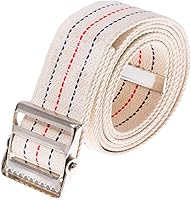
The COW&COW Transfer and Gait Belt is a 2 in cotton webbing belt with a nickel-chrome plated steel buckle. The beige belt with stripes is offered in a 100 in length, with other stated sizes of 54, 60, and 72 in, and a stated webbing capacity of 350 lb.
This option may suit a caregiver who needs the 100 in version or wants to compare several length choices. Its 2 in width is narrower than the 4 in options above, so fit, comfort, and the patient's tolerance should guide the choice.
COW&COW states that the belt can be machine washed and hang dried. Follow the care directions and inspect the webbing and buckle before each use.
How tight should a gait belt be?
A gait belt should be snug enough that it does not slide up or rotate during movement, but it should not restrict breathing or cause pain. Place it over clothing and check the fit before the patient stands.
Leave enough room for a secure handhold without creating a loose loop. Recheck the belt if the patient changes clothing, sits for a long period, or reports discomfort.
A small waist may need a shorter adjustment range. See the best gait belt small options if a standard belt leaves too much slack.
Who should not use a gait belt without guidance?
A person should not use a gait belt without trained guidance when the patient cannot bear weight, cannot follow instructions, has sudden weakness, or needs full-body support. Skin, abdominal, chest, breathing, surgical, or pain concerns may also affect the choice.
Ask a nurse, therapist, or other qualified professional to assess the transfer method when you're unsure. A gait belt is a tool for an appropriate transfer plan, not a universal answer for every patient.
For questions about the equipment involved in care, you can also review Is a Wheelchair Considered a Medical Device? A Quick Look.
What is a gait belt for nursing, in simple terms?
A gait belt for nursing is a waist belt that helps a caregiver steady and guide a patient who can participate in movement. It can support walking, standing, sitting, and transfers, but it is not meant to lift someone who cannot bear weight.
Choose by fit, belt width, buckle, handles, and the patient's ability to help. Pick the NYOrtho belt for a 28 to 55 in waist range and 6 handles, the Vive belt for up to 350 lb and 7 padded handles, or the COW&COW belt when a 100 in length and 2 in cotton webbing suit the transfer plan.
Frequently asked questions
What is a gait belt used for in nursing?
A gait belt is used to give a caregiver a secure place to hold while helping a patient stand, walk, sit, or move between surfaces. It can improve control during assisted movement, but it is not designed to lift a patient who cannot bear weight or replace a mechanical patient lift.
Can a gait belt be used to lift a patient?
No. A gait belt is for steadying and guiding a patient who can support some of their own weight.
Do not use it as a sling or pull a patient up by the belt.
A mechanical lift or other approved transfer method may be needed for a person who cannot assist.
Where should a gait belt be placed?
Place the gait belt around the patient's waist, over clothing, and below the chest area. It should be snug without restricting breathing or causing pain.
Check the buckle and fit before movement, and follow the patient's care plan or facility procedure.
Should every patient use a gait belt?
No. A gait belt may be unsuitable for some patients, including people with certain abdominal, chest, skin, surgical, or breathing concerns.
A trained professional should assess the patient's strength, balance, weight-bearing ability, and care instructions before choosing a transfer method.